Flushing Town Hall
137-35 Northern Boulevard | Flushing | built 1862
Open on the map7 entries

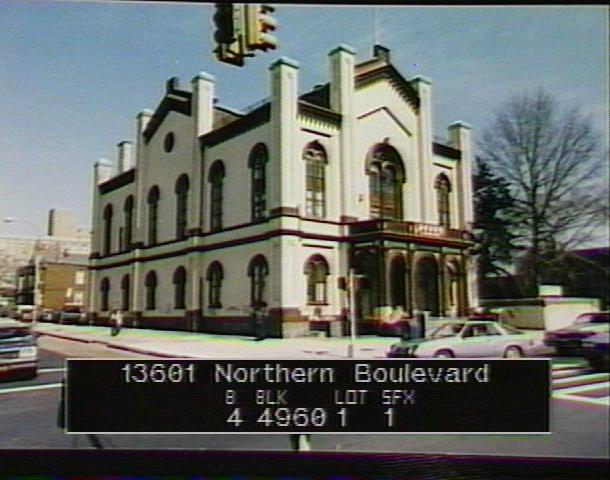
The city photographed every building for its tax records around 1940 and again in the 1980s. NYC Municipal Archives.
Written with AI from the source each entry cites, then fact-checked.
- 1862
Flushing builds a Romanesque Revival town hall
The two-story brick town hall went up in 1862 in an early form of the Romanesque Revival style. Thin buttresses split its front into three parts, rows of small arched corbels run along the roofline, and a raised triple-arched portico topped by a balustraded entablature marks the entrance.
“Striking in the picturesqueness of its profiles; the Flushing Courthouse or Town Hall is a noteworthy example of an early phase of the Romanesque Revival style…”
- 1862
The new town hall becomes home to Flushing's Civil War artillery volunteers
From 1862 to 1900 the hall hosted nearly every important event in town, from public meetings to costume balls and small opera productions. During the Civil War it housed Flushing's Volunteer Artillery Unit, later the Union Army's 34th Independent New York Battery, and the hall hosted a farewell ceremony when the men marched off to war.
- 1898
Flushing joins Greater New York and its town hall loses its government role
The building had been the seat of the village of Flushing's government. That ended in 1898, when the village became part of the newly consolidated City of Greater New York.
Source: Wikipedia
- 1938
A rear wing with a block of jail cells is added to the town hall
In 1938 a small wing was built onto the back of the building to hold a block of jail cells. The earliest photographs show the brick hall painted a light color, a practice dropped after the paint failed to adhere during a restoration.
“A small rear wing was added in 1938 containing a block of jail cells.”
Source: Wikipedia
- 1964
The old town hall serves as a police precinct for the World's Fair
In its later years the building served as a courthouse and as offices for municipal bureaus. During the 1964-65 New York World's Fair it was put to work as a police precinct for the fair.
“…offices for municipal bureaus , a nd a police pr e cinct for th e World 1 s Fa ir of 1964 - 65…”
- 1968
The landmarks commission recalls Tom Thumb and Teddy Roosevelt at Flushing Town Hall
Designating the building a landmark on July 30, 1968, the Landmarks Preservation Commission noted that Tom Thumb had performed inside and that Teddy Roosevelt delivered a presidential campaign speech from the portico steps. The report also mentioned the Old Hamilton Rifles, later Flushing's 17th Separate Company, who were once quartered there. The city then owned the hall and leased it to a charity.
“Tom Thumb per formed there , and Teddy Roosevelt gave one of his Presidential campaign speeches from th e steps o f the portico.”
- 1979
The Flushing Council on Culture and the Arts, steward of the hall, begins its work
The Flushing Council on Culture and the Arts, the group that now stewards Flushing Town Hall, has backed local, national and immigrant artists since 1979. The old hall is now an arts center where performers dress in a former jail cell. Recognized as the leading jazz presenter in Queens, it holds monthly jazz jams and concerts by NEA Jazz Masters, and its programs also feature the arts of China, Korea, Latin America and South Asia.
Source: atlasobscura.com
Further reading
- Flushing Town HallWikipedia
Nearby
- Flushing Quaker Meeting House137-16 Northern Boulevard | 7 entries
- Flushing Armory137-58 Northern Boulevard | 2 entries
- Flushing High School35-01 Union Street | 8 entries
- Lewis H. Latimer House138-10 32nd Avenue | 8 entries
- St. George's Episcopal Church135-33 39th Avenue | 9 entries
- Bowne House37-01 Bowne Street | 5 entries