Flushing Quaker Meeting House
137-16 Northern Boulevard | Flushing | built 1694
Open on the map7 entries

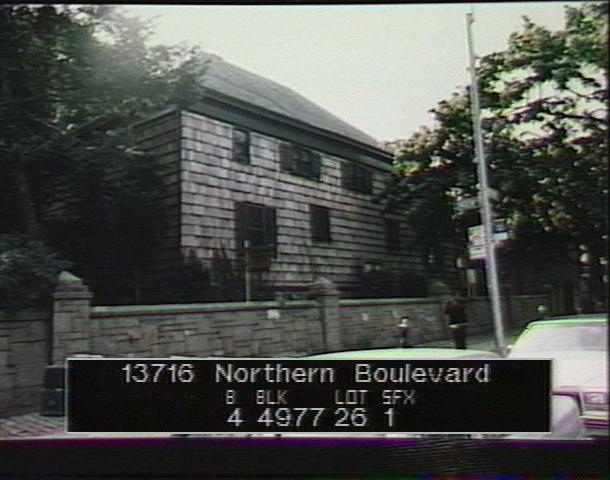
The city photographed every building for its tax records around 1940 and again in the 1980s. NYC Municipal Archives.
Written with AI from the source each entry cites, then fact-checked.
- 1667
John Bowne gives the land that becomes the Friends' burial ground
John Bowne gave land for a Quaker burial ground as early as 1667. Graves there went unmarked until 1835, and later ones have only plain low stones. Those buried here include John Murray Jr., who in 1785 founded the New York Society for the Manumission of Slaves, and Samuel Leggett, who organized the New York Gas Light Company in 1823.
“The land had been given for a burial ground as early as 1667 by John Bowne.”
- 1694
Flushing's Quakers hold the first meeting in their new meeting house
The first meeting in the building took place on November 24, 1694, in a small frame structure on land that John Bowne and John Rodman had acquired in 1692. That first building survives as the eastern third of today's meeting house, which the city calls its oldest standing house of worship.
- 1696
The New York Yearly Meeting of Friends begins gathering in Flushing
When Quakers organized the province's New York Yearly Meeting in 1695, they agreed to hold it at the Flushing meeting house. The yearly gathering met in the building from 1696 until 1778, a sign of how quickly the house became important to the Society of Friends.
“It continued to assemble there from 1696 to 1778.”
- 1716
The Quakers enlarge their meeting house to its present size
Between 1716 and 1719 the building was expanded to its present size; uneven window spacing on the south side still marks the seam. It rests on a frame of 40-foot oak timbers, each hand hewn from one tree, under a hip roof nearly as tall as its two stories. Separate double doors on the south front served men and women.
“In 1716-1719 the building was enlarged to its present size.”
- 1716
William Burling and John Farmer preach against slavery at the meeting house
By 1716 the meeting house had become a pulpit for antislavery preaching by William Burling and John Farmer. John Woolman, Elias Hicks and Matthew Franklin, who is buried in the graveyard, followed them in attacking slavery during the colonial period.
“As early as 1716 the Flushing Meeting House was the scene of preaching against slavery by William Burling and John Farmer.”
- 1776
The British army turns the meeting house into a prison after the Battle of Long Island
Following the disastrous 1776 Battle of Long Island, British troops briefly held prisoners in the building. For the rest of the occupation, until 1783, it was used to store hay and as a hospital. Quaker services resumed in 1785 and have continued since.
“…the Flushing Meeting House was briefly used by the British ar!Tly as a prison…”
- 2012
Quakers accuse a builder next door of digging into their graveyard
In 2012 the Religious Society of Friends said a construction company on the neighboring lot had dug into its burial ground, which holds hundreds of unmarked graves, and fenced off disputed land. The company pulled back after the Landmarks Preservation Commission threatened a $5,000 fine, while denying any graves were disturbed. A Bowne House officer said the area might hold John Bowne and his wives.
“…their graveyard, which contains hundreds of unmarked graves, was dug into by a construction company working on an adjacent lot…”
Source: Wikipedia
Further reading
- Old Quaker Meeting House (Queens)Wikipedia
Nearby
- Flushing Town Hall137-35 Northern Boulevard | 7 entries
- Flushing Armory137-58 Northern Boulevard | 2 entries
- St. George's Episcopal Church135-33 39th Avenue | 9 entries
- Flushing High School35-01 Union Street | 8 entries
- Lewis H. Latimer House138-10 32nd Avenue | 8 entries
- Bowne House37-01 Bowne Street | 5 entries