Bowne House
37-01 Bowne Street | Flushing | built 1661
Open on the map5 entries

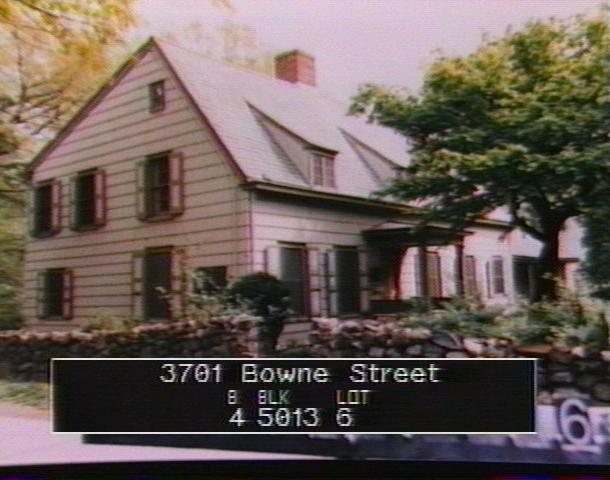
The city photographed every building for its tax records around 1940 and again in the 1980s. NYC Municipal Archives.
Written with AI from the source each entry cites, then fact-checked.
- 1661
John Bowne builds the first part of the house, later called the oldest in Queens
John Bowne built the house's original section in 1661, a kitchen with bedrooms above it. Additions followed in 1680 and 1691; a north wing came in 1830, when the roof was also raised. The steep main roof, with three shed dormers, shows a medieval influence. Nine generations of Bownes made their home in this wood-frame house.
“The original portion, containing a kitchen with bedrooms upstairs, was constructed by John Bowne in 1661.”
- 1662
Peter Stuyvesant has John Bowne arrested for hosting a Quaker meeting in his house
A Quaker meeting held here in 1662 led Peter Stuyvesant, Director-General of New Netherland, to arrest the owner, John Bowne. Bowne took his case to the Dutch West India Company and won, setting a precedent for religious freedom in the colony that later helped shape constitutional guarantees of free worship, speech and assembly.
“…the location of a Quaker meeting in 1662 that resulted in the arrest of its owner, John Bowne, by Peter Stuyvesant…”
Source: Wikipedia
- 1694
Flushing's Quakers move their worship from Bowne's house to a new meeting house
For over three decades the Bowne house served Flushing's Quakers as their place of worship. That ended in 1694, when the Friends Meeting House of Flushing was built. Bowne himself had been fined and jailed for defying Governor Stuyvesant's ban on the Quakers, whom Stuyvesant called an abominable sect.
“…used for over thirty years as a place of worship before the Friends Meeting House of Flushin g was built in 1694…”
- 1945
The Bowne family hands its ancestral house to a historical society
The Bownes stayed for generations, finally deeding the house to the Bowne Historical Society in 1945, and it opened as a museum in 1947. Family members over the years included abolitionists, among them Robert Bowne, a founder of the Manumission Society of New York in 1784, and residents documented as helping fugitive slaves on the Underground Railroad.
“…several generations of the Bowne family lived in the house until 1945, when the family deeded the property to the Bowne Historical Society…”
Source: Wikipedia
- 1966
The Landmarks Preservation Commission designates Bowne House a landmark
The commission named the house a landmark on February 15, 1966, after two hearings at which nine speakers, including the Bowne House Historical Society's president, spoke in favor and none against. It called the house an important symbol of religious liberty and noted that the society had run it as a museum and a Shrine to Religious Freedom.
“…the Bowne House is an extremely important example of early English Colonial architecture ... an important symbol of religious liberty…”
Further reading
- John Bowne HouseWikipedia
Nearby
- Kingsland Homestead143-35 37th Avenue | 8 entries
- Bowne Street Community Church143-11 Roosevelt Avenue | 9 entries
- Flushing High School35-01 Union Street | 8 entries
- Flushing Armory137-58 Northern Boulevard | 2 entries
- Flushing Town Hall137-35 Northern Boulevard | 7 entries
- Flushing Quaker Meeting House137-16 Northern Boulevard | 7 entries