Lewis H. Latimer House
138-10 32nd Avenue | also 34-41 137th Street, 34-42 Leavitt Street | Flushing | built 1990
Open on the map8 entries

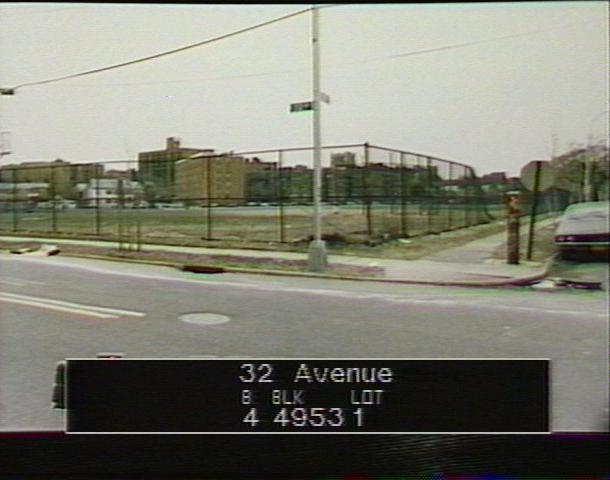
The city photographed every building for its tax records around 1940 and again in the 1980s. NYC Municipal Archives.
Written with AI from the source each entry cites, then fact-checked.
- 1889
A Queen Anne frame house goes up on Holly Avenue for Emma and William Sexton
Emma Sexton bought a 50-by-100-foot lot on the north side of Holly Avenue, west of Kissena Boulevard, in 1887 and had the house up by 1889; she and her husband William, a house painter, lived in it until 1902. The two-and-a-half-story L-shaped frame house was sheathed in clapboards and trimmed in Queen Anne fashion, with bays, decorative vergeboards, eave brackets and a front gable covered in fish-scale shingles. It was moved to its present corner in 1988.
- 1902
Inventor Lewis Latimer buys the house, his family's only owned home in New York
Lewis and Mary Wilson Latimer bought the house in 1902 and lived there for twenty-six years. Latimer had made the drawings for Alexander Graham Bell's 1876 telephone patent application and devised a method of making long-lasting carbon filaments that made light bulbs affordable, then served as a patent expert for Thomas Edison's company.
“This Queen Anne style frame house... was acquired by Lewis and Mary Wilson Latimer in 1902. It was the only house the Latimers owned in New York…”
- 1908
Lewis Latimer helps found the Flushing Unitarian Church while his home hosts W.E.B. DuBois and others
Settled in Flushing, the Latimers took an active part in their new community. In 1908 Lewis Latimer was among the founders of the Flushing Unitarian Church, and for years he was an officer of the local Grand Army of the Republic chapter. Their Flushing house drew Black cultural and political leaders, among them W.E.B. DuBois, the author Jessie Fauset, the composer Harry T. Burleigh and James Weldon Johnson.
“In 1908, Lewis Latimer was one of the founders of the Flushing Unitarian Church…”
- 1912
Latimer draws his own plans to enlarge the attic with two dormers
An experienced draftsman, Latimer designed the 1912 enlargement of the attic with two shed-roofed dormers and drew the axonometric plans filed with the Queens Department of Buildings; his next-door neighbor, builder M.F. Johnson, did the work. Earlier he had added a one-story wing holding his studio and study, which his granddaughter Dr. Winifred Norman remembered as holding his books, drafting instruments and a chamber organ.
“Latimer designed the addition and prepared the axonometric drawings of the house which were filed with the Department of Buildings in Queens…”
- 1928
After Latimer's death, his artist daughter Louise turns the front porch into her studio
When Lewis Latimer died in 1928 the house went to his daughters, Louise Latimer and Jeanette Latimer Norman. Louise, an artist, stayed on, renting rooms to students and older people and enclosing the front porch to make one large studio and living room out of it and the front parlor. The family kept the house until her death in 1963, when it was sold to a neighbor.
“Louise Latimer, who was an artist, continued to occupy a portion of the house while generating income by renting rooms…”
- 1988
Neighbors save the Latimer house from demolition and move it to Leavitt Field
That year the owner sold the house to a developer who meant to tear it down for two two-family houses. A Committee to Save the Latimer House, led by Rev. Timothy Mitchell of Ebenezer Baptist Church and Latimer's granddaughter Dr. Winifred Norman, raised money; Borough President Claire Shulman gave $25,000 toward the move. The house was carried to Leavitt Field, a city recreation ground facing Latimer Gardens, the housing project named for the inventor.
- 1995
The Landmarks Preservation Commission designates the Lewis H. Latimer House
The city made the house an individual landmark in 1995, a month after a February 14 hearing at which twenty-four witnesses spoke in favor, among them the Lewis H. Latimer Fund and a representative of Borough President Claire Shulman. The Commission called it the most significant site in the city tied to Latimer, and plans were then underway to restore it as a house museum.
- 2024
A renovation funded by a $750,000 grant is completed at the house museum
Now a museum run by the Lewis H. Latimer Fund and owned by the city Parks Department, the house was awarded $750,000 in 2022 to upgrade it, and the work wrapped up in June 2024. The Fund has worked to return the house to its 1912 to 1928 condition, taking out the enclosed front porch, rebuilding Latimer's studio and returning the rooms inside to their original layout.
Source: Wikipedia
Further reading
- Lewis H. Latimer HouseWikipedia
Nearby
- Flushing High School35-01 Union Street | 8 entries
- Flushing Town Hall137-35 Northern Boulevard | 7 entries
- Flushing Armory137-58 Northern Boulevard | 2 entries
- Masjid Hazrat Abu Bakr Siddique141-47 33rd Avenue | 1 entry
- Flushing Quaker Meeting House137-16 Northern Boulevard | 7 entries
- Kingsland Homestead143-35 37th Avenue | 8 entries