Kingsland Homestead
143-35 37th Avenue | Flushing | built 1785
Open on the map8 entries

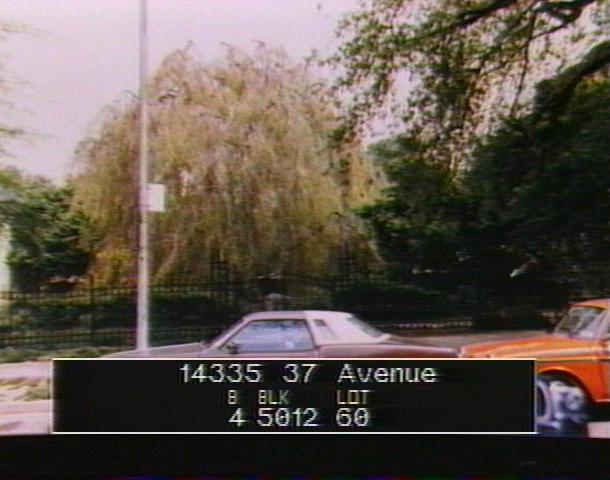
The city photographed every building for its tax records around 1940 and again in the 1980s. NYC Municipal Archives.
Written with AI from the source each entry cites, then fact-checked.
- 1785
Charles Doughty builds the farmhouse later known as Kingsland
Charles Doughty put up this Flushing house around 1785. It did not start out here: the building has been picked up and relocated twice since then, and today the Queens Historical Society runs it as a museum interpreted to the Victorian era.
“Kingsland was built by Charles Doughty in approximately 1785…”
Source: Wikipedia
- 1801
Sea captain Joseph King buys the house that likely gives Kingsland its name
In 1801 the house passed to Joseph King, a British sea captain who had married into the Doughty family as Charles Doughty's son-in-law. The name Kingsland is thought to come from him. King also put up a stable on the property, and more than a century later the house itself would be moved onto that stable's site.
“British sea captain Joseph King, who bought the home in 1801…”
Source: Wikipedia
- 1923
The planned Flushing Line extension forces Kingsland to move
In 1923, with development expected to follow the proposed extension of the city's Flushing subway line, the house was moved. Its new spot was the site of a stable that Joseph King himself had built.
Source: Wikipedia
- 1965
Neighbors save Kingsland from a shopping center and win it early landmark status
Plans for the Murray Hill Shopping Center put the house at risk in 1965. Local residents rallied to keep it, and that same year the Landmarks Preservation Commission made it one of the first buildings in New York City to be declared a landmark.
“…threatened again in 1965, by the construction of the Murray Hill Shopping Center, but the community was able to save the house…”
Source: Wikipedia
- 1966
The city designates the Weeping Beech in Kingsland's park as a landmark
On April 19, 1966, the Landmarks Preservation Commission designated the Weeping Beech, a tree that the Flushing nurseryman Samuel Parsons had planted on the site after buying a section of a tree on Baron DeMann's estate in Beersal, Belgium. It then stood more than 60 feet tall with a spread of about 85 feet and a trunk 14 feet around. Parks Commissioner Thomas Hoving recommended the designation in a letter.
- 1968
The Kingsland Preservation Committee moves the threatened house to its present site
New construction endangered the house once more in 1968. The Kingsland Preservation Committee, founded three years earlier and later renamed the Queens Historical Society, arranged to have it moved to where it stands today, in the park that also holds Weeping Beech Park.
Source: Wikipedia
- 1973
Kingsland Homestead is dedicated as a museum after long delays
Following years of setbacks after the move, the house was formally dedicated as a museum in March 1973. The Queens Historical Society has its offices inside, and exhibitions there have ranged from Queens during World War II to slavery and its legacy in Queens and on Long Island.
Source: Wikipedia
- 1998
A funeral is held for the Weeping Beech beside the homestead
The Weeping Beech, believed to be the parent of every weeping beech in the country, died in 1997 after 151 years. A funeral for it followed in December 1998. Its remains went to artists for sculptures and benches on a downtown Flushing heritage trail, a ten-foot piece stayed in the park as a memorial, and seven of its offspring still grow around the house.
Source: Wikipedia
Further reading
- Kingsland HomesteadWikipedia
Nearby
- Bowne House37-01 Bowne Street | 5 entries
- Bowne Street Community Church143-11 Roosevelt Avenue | 9 entries
- Flushing High School35-01 Union Street | 8 entries
- Flushing Armory137-58 Northern Boulevard | 2 entries
- Flushing Town Hall137-35 Northern Boulevard | 7 entries
- Masjid Hazrat Abu Bakr Siddique141-47 33rd Avenue | 1 entry