Bowne Street Community Church
143-11 Roosevelt Avenue | Flushing | built 1892
Open on the map9 entries

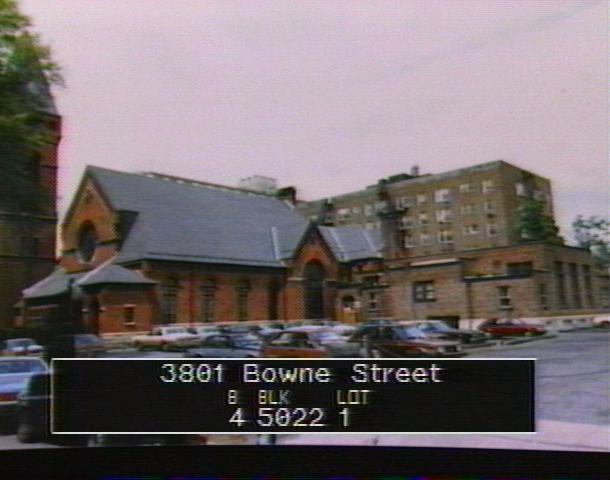
The city photographed every building for its tax records around 1940 and again in the 1980s. NYC Municipal Archives.
Written with AI from the source each entry cites, then fact-checked.
- 1873
The Reformed Dutch congregation buys a corner lot from Mary B. Parsons for a new church
Organized in 1842, Flushing's Reformed Dutch congregation soon grew too big for its first church near the busy commercial district. In 1873 it bought an empty plot of 186 by 193 feet at the northeast corner of Bowne and Amity streets, the latter now Roosevelt Avenue, from Mary B. Parsons. A newspaper later called the corner "perhaps the best site in Flushing for a church," though most blocks farther east were still open land.
- 1877
A parsonage goes up on the church's new lot while the church itself waits
In 1877 the congregation put up a parsonage on the southeast part of this lot, an earlier building on the site of today's church, but raising the money for the church itself took almost 20 more years. An 1882 history of the congregation praised the parsonage as equal to any in the denomination while admitting that the planned church was still a "castle in the air." The parsonage was sold in 1899.
“In 1877, a parsonage was built to serve the church on the southeast part of the lot…”
- 1890
Rev. James Demarest becomes pastor and gets the long-delayed church built
Rev. James Demarest (1832-1913), a leading cleric in the Reformed Church's Synod of New York, took over as pastor in December 1890 and served until 1897. Ordained after graduating from the New Brunswick seminary in 1856, he had led several congregations in New Jersey and New York. Telling his flock that God would provide the means for a new house of worship, he succeeded in raising the money where his predecessor had not.
- 1891
Builders lay the cornerstone of a red-brick Romanesque Revival church attributed to G. E. Potter
Press accounts of the time named "G. E. Potter" as the church's designer and Edward Richardson as its builder. The cornerstone went down on October 10, 1891. Built of red brick, the church has round-arched openings, elaborate brickwork and stone trim, and a dominant bell tower at the corner whose bell came from the Meneely Bell Foundry in Troy.
“The cornerstone was laid on October 10, 1891. Clad in red brick, the church featured arched openings, intricate brickwork…”
- 1892
The new Reformed Dutch church is dedicated six months after its first services
Worship began in the building in May 1892, and the formal dedication followed on November 6. With seats for roughly 600 to 700 people, it was taller and larger than the congregation's first church. The north end held a Sunday school room, classrooms and a library on the ground floor, with a social room and kitchen, a parlor for the ladies' societies and the pastor's study above.
- 1899
Congregant Agnes Northrop of Tiffany Studios designs a floral memorial window for the church
In 1899 the church installed an opalescent stained-glass window in its east transept designed by Agnes Fairchild Northrop (1857-1953), a Flushing native and member of the congregation who worked for Tiffany Studios. It honors Robert Baker, who was tied to two of Flushing's largest nurseries, and so carries an elaborate floral design. Five years later, in 1904, she created a second window here, the "Vision of Saint John," for her father, Allen Parkhill Northrop, a deacon from 1860 to 1903.
“…designed by Flushing native and member of the congregation, Agnes Fairchild Northrop (1857-1953) as a memorial to Robert Baker.”
- 1929
The Skinner Organ Company of Boston supplies a three-manual pipe organ for $22,800
In 1929 the Skinner Organ Company of Boston installed the church's organ, Opus 813, with three manuals, 34 stops and 46 ranks, at a cost of $22,800. It replaced an instrument of about 1892 by Reuben Midmer & Sons of Brooklyn. Peter Batchelder of New York began enlarging the organ in 1977, and John Wessel carried the renovation on from 1984 to 1988, altering its console.
Source: Wikipedia
- 1974
The Reformed Church merges with First Congregational to become Bowne Street Community Church
In 1974 the Reformed Church of Flushing merged with Flushing's First Congregational Church, and the building took the name the Bowne Street Community Church, linked to both the Reformed Church in America and the United Church of Christ. From 1988 it was also tied to the Taiwanese Zion Christian Church, and an independent Korean congregation, the New York Yeram Church, holds services and keeps offices here, reflecting the Taiwanese and Korean arrivals who reshaped Flushing from the 1960s on.
- 2016
The city landmarks the church even though its own leaders testify against it
At an October 2015 hearing, Dr. Kent Chin of the church's governing board spoke for landmark status on the owner's behalf. But at the November 15, 2016 hearing, trustee Samuel Tai and pastor Aaron Chen, chair of the governing board, opposed it, while ten speakers, including Council Member Peter Koo and Queens Borough Historian Jack Eichenbaum, supported it. The Landmarks Preservation Commission designated the church on December 13, 2016.
“Two representatives of the church, Samuel Tai, a trustee, and Aaron Chen, pastor and chair of the governing board, spoke against designation.”
Further reading
Nearby
- Bowne House37-01 Bowne Street | 5 entries
- Kingsland Homestead143-35 37th Avenue | 8 entries
- Flushing High School35-01 Union Street | 8 entries
- Flushing Armory137-58 Northern Boulevard | 2 entries
- Flushing Quaker Meeting House137-16 Northern Boulevard | 7 entries
- Flushing Town Hall137-35 Northern Boulevard | 7 entries