Pike Street Synagogue
15 Pike Street | also 13 Pike Street | Two Bridges | built 1904
Open on the map10 entries

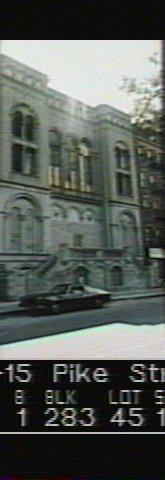
The city photographed every building for its tax records around 1940 and again in the 1980s. NYC Municipal Archives.
Written with AI from the source each entry cites, then fact-checked.
- 1882
Congregation Sons of Israel Kalwarie buys a residential building at 13-15 Pike Street and turns it into a synagogue
In 1882 a congregation of Russian-Polish Jews, founded in 1853 and by then calling itself the Sons of Israel from Kalwarie after a small town on the Polish-Lithuanian border, bought the property at 13-15 Pike Street. The building, previously a residence, was remodeled for worship. This was an earlier building on the site of today's synagogue, which replaced it in 1903-04.
- 1904
A wedding in the unfinished synagogue draws a crowd of women that needs police to control
Victoria Gordon, daughter of building committee chairman Louis Gordon, married lawyer Joseph Edelson in the new synagogue about three weeks before its dedication. Crowds filled Pike Street for a block, and police reserves from the Madison Street station formed a human wall to keep the onlookers back. Though the congregation was Orthodox, an orchestra and a boys' choir of twenty were allowed to perform. The Sun said no wedding on the East Side in years had matched it.
Source: Daytonian in Manhattan
- 1904
The new Pike Street synagogue is dedicated before a crowd that far exceeds its 1,500 seats
The limestone synagogue, built for about $85,000 by the Tribune's estimate, was dedicated on a Sunday afternoon in March 1904. Admission was by ticket, yet several thousand people were turned away, and twenty police officers under Captain Shaw kept order. Rabbi Samuel Schulman used the occasion to urge Jewish immigrants to embrace American civic life and to make sure their children also learned Hebrew.
Source: Daytonian in Manhattan
- 1904
Alfred E. Badt designs a limestone synagogue with twin staircases and Romanesque arches
The congregation hired Alfred E. Badt, an architect so obscure that city directories list him only for 1904. His three-story limestone front rises over a raised basement, with a double staircase leading to a recessed porch of slender columns. Round arches, a corbel table and a blind arcade draw on the German Rundbogenstil, while classical moldings reflect the taste of the period after the 1893 Chicago fair.
“Little is known of Badt. His name appears in New York City directories only for the year 1904.”
- 1905
Eddie Cantor studies and celebrates his bar mitzvah in the synagogue's basement school
The synagogue's basement held a school, and Eddie Cantor studied there as a boy. According to Daytonian in Manhattan, he celebrated his bar mitzvah at the synagogue about a year after its 1904 opening.
Source: Daytonian in Manhattan
- 1909
Thousands line the Lower East Side for the funeral of Cantor Israel Cooper
Israel Cooper, an aged and well-known cantor who had led the congregation for 25 years and earlier served in Bucharest, died at 69. His funeral began at the Pike Street synagogue, where a hundred well-known cantors sang, before the procession moved to the Beth Medrasch synagogue on Norfolk Street. The Tribune counted 1,200 people inside and thousands more along the route.
Source: Daytonian in Manhattan
- 1911
Rabbi Judah Magnes's lectures here help lay the groundwork for the Young Israel movement
In 1911 the Reform rabbi Judah Magnes was invited to give a series of Friday evening talks at the synagogue. Thousands crowded Pike Street on the night of his first address, and police were called in to keep order. Congregants wanted a traditional Jewish life conducted in an American way, and the lectures are credited with laying the foundation for the Young Israel movement.
Source: Daytonian in Manhattan
- 1917
A basement fire destroys irreplaceable records and scrolls at the synagogue
A fire started in the synagogue basement in January 1917. The structure itself suffered little damage, but the congregation lost valuable Jewish records, costly books and scrolls. The Sun reported that many of the lost items could not be replaced.
Source: Daytonian in Manhattan
- 1979
Congregants find the synagogue padlocked after trustees sell it to a Chinese group
Just before Rosh Hashanah in 1979, worshippers arrived to find themselves locked out. Trustees had accepted a $180,000 offer from a Chinese group without telling members, saying few Jews remained in the neighborhood and the money would maintain the congregation's cemetery in Queens. Only about two dozen people were attending Saturday services, down from the 1,500 the building could hold. Members held services on the sidewalk and fought the sale on legal grounds.
Source: Daytonian in Manhattan
- 1997
The city designates the Pike Street Synagogue a landmark after its conversion to a Buddhist temple
The Landmarks Preservation Commission designated the synagogue on May 20, 1997, calling it a rare surviving synagogue building from the era when the Lower East Side was the main entry point for Jewish immigrants. The congregation, started in 1853, had left the building, and it stood vacant for several years. It has since been rehabilitated, with commercial space on the ground floor, a Buddhist temple on the main level and apartments above.
“…rare surviving synagogue building from that period of New York's history when the Lower East Side served as America's main portal for millions of Jewish immigrants (LPC report, May 20, 1997)…”
Further reading
- The 1904 Sons of Israel Kalwarie Synagogue --Nos. 13-15 Pike StreetDaytonian in Manhattan
Nearby
- Knickerbocker Station Post Office128 East Broadway | 4 entries
- Jarmulowsky Bank Building56 Canal Street | 12 entries
- St. Teresa Church143 Henry Street | 3 entries
- Henry Rutgers Houses, Building 145 Pike Street | 2 entries
- Eldridge Street Synagogue12 Eldridge Street | 12 entries
- Kletzker Brotherly Aid Society and Kobre Bank Building41 Canal Street | 6 entries