Otto Kahn House
1100 5th Avenue | also 1 East 91st Street | Carnegie Hill | built 1918
Open on the map12 entries

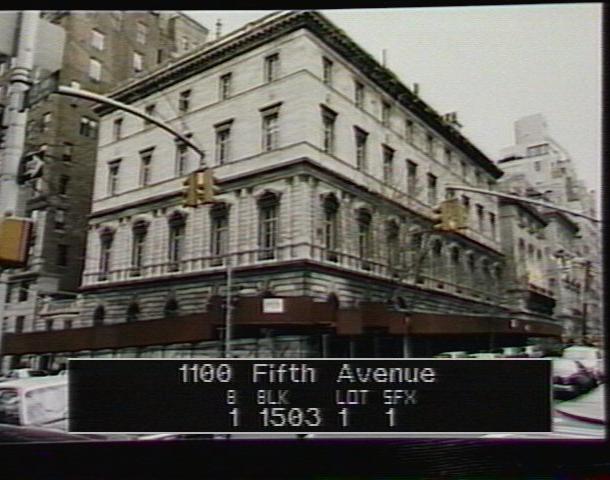
The city photographed every building for its tax records around 1940 and again in the 1980s. NYC Municipal Archives.
Written with AI from the source each entry cites, then fact-checked.
- 1913
Otto Kahn buys the Fifth Avenue corner lot from Andrew Carnegie
Andrew Carnegie bought every lot on Fifth Avenue between 90th and 92nd Streets in 1898 and kept several of them to protect the value of his own mansion. When he tried in 1906 to sell half the northeast corner to Lloyd Bryce, neighbors led by William D. Sloane sued and blocked the sale. In 1913 Carnegie sold the corner to banker Otto Kahn, whom he believed would build a house that suited the street; sources disagree on whether Kahn paid $675,000 or paid $725,000 and took back a $675,000 mortgage from Carnegie.
Source: Wikipedia
- 1917
The Times praises the unfinished Kahn house for its wartime flag
On February 18, 1917, The New York Times calls Otto Kahn's nearly complete mansion a noteworthy addition among the great residences north of 59th Street. Because construction continues through the war, the paper notes with approval that Kahn has hung an American flag from an upper window overlooking Fifth Avenue. The house is not finished until 1918.
Source: Daytonian in Manhattan
- 1918
Stenhouse and Gilbert complete a mansion called the city's finest Italian Renaissance house
Begun in 1913 and finished only after the First World War, the house was the work of J. Armstrong Stenhouse, a British architect, with C. P. H. Gilbert as associate. It is four stories of gray limestone over a deep basement, with a carriageway tucked behind the 91st Street wall and a second-floor piano nobile. The Landmarks Commission later judged it the finest Italian Renaissance mansion in the city, and The New York Times had welcomed it on completion.
- 1918
Otto Kahn, Metropolitan Opera chairman, makes the house the setting for his art collection
Otto Kahn, born in Germany, established himself as a banker in the United States in 1893 and chaired the Metropolitan Opera's board, bringing Gatti-Casazza and Toscanini from La Scala in 1908 and making a personal appeal for funds in 1931. He backed Eva Le Gallienne's Civic Repertory Company and the Provincetown Playhouse and helped bring Diaghilev's Russian Ballet and the Moscow Art Theatre to America. His mansion housed his art collection, and after his death the Chamber of Commerce likened his houses to Medici palaces.
“He was, at the time of his death, considered by many to be the greatest patron of the arts in the United States.”
- 1920
Kahn throws a debutante ball at the mansion for his daughter Margaret
In the house's early years, Otto and Addie Kahn host theatrical figures and financiers in the ballroom. In 1920 they stage a debutante ball there for their daughter Margaret, whose wedding is held there in 1928. The family mainly lives on 91st Street and uses Oheka Castle on Long Island in the summer.
“…a debutante ball for the Kahns' daughter Margaret in 1920…”
Source: Wikipedia
- 1924
Roger Kahn's jazz orchestra rehearses in the mansion
In 1924 the youngest Kahn son, Roger, started a jazz orchestra, and the band rehearsed inside the family mansion. The house was a social center in those years: the Kahns held a debutante ball for their daughter Margaret in 1920, hosted a Persian art exhibition in 1927 and held Margaret's wedding there in 1928. Theatrical figures and financiers were frequent guests in the ballroom.
Source: Wikipedia
- 1934
The Convent of the Sacred Heart buys the Kahn house two months after his death
Kahn died of a heart attack in March 1934 after tentatively agreeing to sell. The Convent of the Sacred Heart bought the house that May for $900,000, and Kahn's estate sued to lift a restriction that Carnegie had placed limiting the block to residences. Neighbors did not object so long as the building's height stayed the same. The former ballroom became the school chapel.
Source: Wikipedia
- 1934
The Chamber of Commerce likens Kahn's Fifth Avenue house to the palaces of the Medici
After Otto Kahn's death in 1934, the Chamber of Commerce issues a citation that compares his Fifth Avenue house, along with his country home at Cold Spring Harbor, to the palaces of the Medici. The tribute reflects his standing as a patron of the arts; the Landmarks Commission later records it in designating the mansion.
“Cold Spring Harbor, Long Island, with the palaces of the Medici…”
- 1940
Sacred Heart buys the neighboring Burden House and links it to the Kahn mansion
Having moved into the Kahn mansion in 1934, the Convent of the Sacred Heart acquires the adjoining James A. Burden House in 1940 and runs a boarding school there. The two houses are joined by a passage. The main school, from kindergarten through high school, stays in the Kahn House.
“Sacred Heart acquired the neighboring Burden House in 1940, using that house as a boarding school. A connection was built between the Burden and Kahn houses.”
Source: Wikipedia
- 1971
The film The Anderson Tapes shoots scenes inside the Kahn mansion
The Italian Renaissance palazzo, by then owned by the Convent of the Sacred Heart, serves as a filming location for part of the 1971 heist film The Anderson Tapes. It later appears in other productions, including the 2009 film Duplicity and a 1984 Julio Iglesias music video, as the school rents its rooms for shoots.
“…the 1971 movie The Anderson Tapes was partially filmed at the Kahn House…”
Source: Wikipedia
- 1974
The Landmarks Commission designates the Kahn house over the school's objection
At 1970 hearings, seven witnesses supported landmark status for the Kahn house, while three representatives of the Convent of the Sacred Heart, its owner and occupant since 1934, objected. The commission designated it on February 19, 1974, calling it the finest Italian Renaissance mansion in New York and noting its restrained dignity on a prominent Fifth Avenue corner.
“Seven witnesses spoke in favor of designation at the hearings. Three representatives from The Convent of the Sacred Heart spoke in opposition to designation.”
- 1994
Sacred Heart cleans and restores the mansion's limestone facade
In 1994 the school cleans and restores the exterior of the Kahn mansion, which then looks as it did when completed in 1918. The house is faced in imported French limestone, in imitation of the Palazzo della Cancelleria in Rome.
Source: Daytonian in Manhattan
Further reading
- Otto H. Kahn HouseWikipedia
Nearby
- James A. Burden House7 East 91st Street | 8 entries
- John Henry Hammond House9 East 91st Street | 15 entries
- Nightingale-Bamford School20 East 92nd Street | 5 entries
- Cooper Hewitt, Smithsonian Design Museum (Carnegie Mansion)2 East 91st Street | 13 entries
- Spence School22 East 91st Street | 6 entries
- The Jewish Museum (Warburg Mansion)1109 5th Avenue | 11 entries