New York County Courthouse
60 Centre Street | also 474 Pearl Street | Civic Center | built 1921
Open on the map12 entries

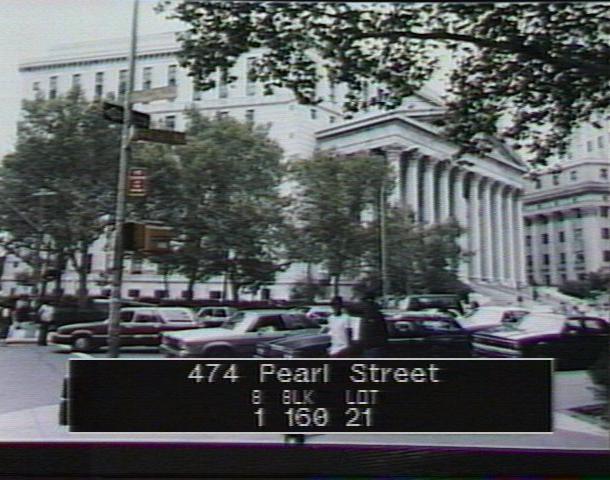
The city photographed every building for its tax records around 1940 and again in the 1980s. NYC Municipal Archives.
Written with AI from the source each entry cites, then fact-checked.
- 1913
Guy Lowell wins a competition with a circular courthouse design
Boston architect Guy Lowell won a 1913 design competition for a new county courthouse with a proposed circular building, but the presiding justices rejected the costly plan later that year. Lowell revised the design into a smaller hexagonal, Roman classical structure on a reduced budget.
Source: Daytonian in Manhattan
- 1919
The courthouse plan is cut from a round building to a hexagon costing about $6 million
Seven years after Guy Lowell's design was accepted, the Real Estate Record & Builders' Guide reported on November 29, 1919 that final action had been taken on the plan, with radical changes in size, layout and cost. His round building had been projected at $15 to $20 million. The hexagonal replacement was expected to cost about $6 million and hold 32 Supreme Court courtrooms and ten for the City Court.
Source: Daytonian in Manhattan
- 1920
Ashes dumped in the courthouse excavation force a $400,000 cleanup
In November 1920 the Evening Star of Washington reported that the cartage firm Holland & Co. had been dumping ashes into the courthouse excavation since February 1918 and kept doing so until recently. The city now faced a bill of nearly $400,000 to haul the ashes away before construction could begin, another delay for the project.
Source: Daytonian in Manhattan
- 1927
The courthouse opens two weeks after its architect's death
The New York County Courthouse's dedication ceremony took place in February 1927, two weeks after architect Guy Lowell died, with Chief Judge Benjamin Cardozo and two other Court of Appeals judges in attendance. Lowell had won the design competition fourteen years earlier, in 1913, and did not live to see the finished building.
Source: Wikipedia
- 1936
A WPA mural is to be erased after Harlem leaders protest its image of a Black man eating watermelon
On December 19, 1936, the Detroit Tribune reported that Harlem leaders had protested, and the Municipal Art Commission had agreed that a WPA mural in the courthouse showing a man eating watermelon was frivolous. The offending picture was to be erased and something else painted in its place.
Source: Daytonian in Manhattan
- 1936
WPA artists paint a mural cycle in the courthouse rotunda
Between 1934 and 1936, Works Progress Administration artist Attilio Pusterla painted "Law Through the Ages" in the courthouse's marble rotunda under the Federal Art Project. The rotunda and the rest of the interior were separately designated a landmark in 1981.
Source: Wikipedia
- 1938
Tammany leader James J. Hines goes on trial here
In September 1938, Tammany Hall leader James J. Hines went on trial in the courthouse, accused of selling political protection to organized crime. A young prosecutor named Thomas E. Dewey argued the case, which ended in a mistrial after the judge ruled Dewey had prejudiced the jury with a slip of the tongue.
Source: Daytonian in Manhattan
- 1947
Santa Claus stands trial in the courthouse in Miracle on 34th Street
The trial of Santa Claus, played by Edmund Gwenn in the 1947 film Miracle on 34th Street, was shot inside the courthouse, and the 1994 remake filmed the building's exterior. The courthouse has since appeared in 12 Angry Men, The Godfather, Wall Street and Goodfellas, among many other films and television series.
“Miracle on 34th Street (1947): the scene of the trial of Santa Claus (Edmund Gwenn) was shot here…”
Source: Wikipedia
- 1955
An elevator operator carries his son, a newly sworn-in justice, up to his chambers
Dominick Lupiano, an Italian immigrant, ran an elevator in the courthouse when it opened and retired after forty years of service. On January 4, 1955, the 84-year-old came back to take his son Vincent A. Lupiano up to his chambers after Vincent was sworn in as a State Supreme Court justice, wearing his old operator's cap for the ride.
Source: Daytonian in Manhattan
- 1966
The city designates the courthouse a landmark for its hexagonal plan and classical detail
The Landmarks Preservation Commission designated the courthouse a city landmark on February 1, 1966, after hearings in October and November 1965 at which one witness spoke in favor and no one opposed. It cited the unusual hexagonal plan, the fine materials, the classical detail and statuary, and the design competition that produced the building.
- 1970
The courthouse hosts conspiracy trials of Black Panther Party members
In 1970, sixteen members of the Black Panther Party went on trial in the courthouse, accused of conspiring to bomb department stores, police stations, and other sites around New York City. The high-profile case ended with a mix of guilty pleas, a murder conviction, and dismissed charges.
Source: Daytonian in Manhattan
- 1988
Lawyers and judges pay to restore the rotunda mural Law Through the Ages
Restoration of Attilio Pusterla's rotunda mural Law Through the Ages began in March 1988. The New York Times reported that the project was being paid for by the lawyers and judges who worked in the building.
Source: Daytonian in Manhattan
Further reading
- New York County CourthouseWikipedia
- The New York County Courthouse - 60 Centre StreetDaytonian in Manhattan
Nearby
- Louis J. Lefkowitz Building80 Centre Street | 4 entries
- Thurgood Marshall United States Courthouse40 Foley Square | 12 entries
- Daniel Patrick Moynihan U.S. Courthouse500 Pearl Street | 6 entries
- Church of St. Andrew20 Cardinal Hayes Place | 8 entries
- Metropolitan Correctional Center150 Park Row | 15 entries
- Chatham Towers170 Park Row | 5 entries