City Hall
254 Broadway | also 1 City Hall, 52 Chambers Street | Civic Center | built 1811
Open on the map16 entries

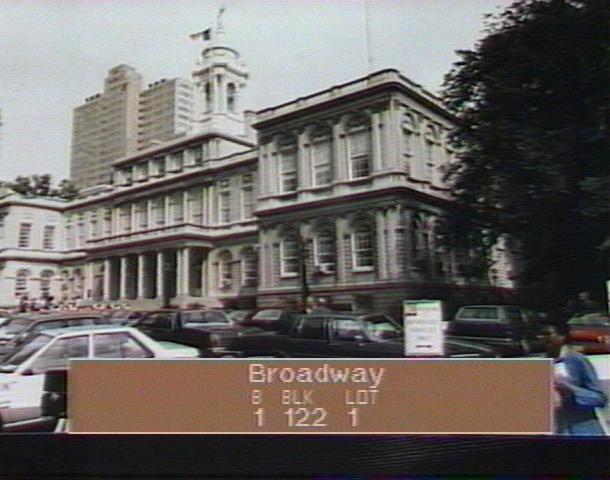
The city photographed every building for its tax records around 1940 and again in the 1980s. NYC Municipal Archives.
Written with AI from the source each entry cites, then fact-checked.
- 1803
Mangin and McComb's winning design breaks ground
A 1802 design competition awards French-born architect Joseph-Francois Mangin and John McComb Jr. a $350 prize for their City Hall design, and the cornerstone is laid on May 26, 1803. Builders face the building in costly Massachusetts marble on three sides but leave the north side in cheaper brownstone, assuming the city would never grow far enough north to see it.
Source: Wikipedia
- 1812
New York's City Hall opens after a decade of construction
Joseph-François Mangin and John McComb Jr. won the 1802 design competition, and the building went up from 1803 to 1812. To save money, its rear facade was finished in brownstone rather than marble. It is the oldest city hall in the United States that still houses its original government functions. Its exterior became a city landmark in 1966 and its interior in 1976.
Source: Wikipedia
- 1824
Lafayette rides up Broadway to City Hall past a crowd of about 50,000
On August 16, 1824, the Marquis de Lafayette landed at Castle Clinton at the start of his tour of the United States. Militia escorted him up Broadway to City Hall, where Mayor Stephen Allen was to greet him. An estimated 50,000 people, about a third of the city, lined the route, and his secretary Auguste Levasseur noted the streets hung with flags and flowers thrown from the windows.
“…an enormous military escort had been assembled to usher him along Broadway and to the New York City Hall, where he was to be greeted by Mayor Stephen Allen…”
Source: Wikipedia
- 1844
George Washington's desk is brought to City Hall
A desk used by George Washington was brought to City Hall in 1844 and sits among the artifacts of the Governor's Room, the reception hall and museum finished in 1815-16. The earliest known mention of a Governor's Room is an 1813 request to the Common Council for window blinds. The room's portrait collection includes paintings by John Trumbull, and its furnishings include pieces by Charles Christian and Honore Lannuier.
“…a desk used by George Washington and brought to City Hall in 1844…”
Source: nyc.gov
- 1857
Two rival police forces brawl on the steps of City Hall
On June 16, 1857, the recently dissolved Municipal Police, loyal to Mayor Fernando Wood, fought the newly formed Metropolitan Police in front of City Hall. The Metropolitan officers had come to arrest the mayor, and the Municipal men tried to stop them. The fight became known as the New York City Police Riot.
Source: Wikipedia
- 1861
President-elect Abraham Lincoln is received in the Governor's Room
In 1861 President-elect Abraham Lincoln was a guest in City Hall's Governor's Room, the chamber where the governor held formal receptions and met visitors. The room's central chamber appears in City Hall's original drawings, with a west chamber added in 1832 and an east chamber in 1848-49.
Source: nyc.gov
- 1861
The body of Colonel Elmer Ellsworth, the first Union officer killed in the Civil War, is brought to City Hall
Elmer Ellsworth, a close friend of Abraham Lincoln who had made his Zouave drill team nationally famous, was shot and killed on May 24, 1861, the first Union officer killed in the war. After his body lay in state in the White House's East Room, it was taken to City Hall in New York, where thousands of Union supporters came to see him. He was buried in his hometown of Mechanicville.
“Ellsworth's body was then taken to the City Hall in New York City, where thousands of Union supporters came to see the first man to fall for the Union cause.”
Source: Wikipedia
- 1865
Abraham Lincoln lies in state in the rotunda as 500,000 mourners wait
Lincoln's funeral train reached Jersey City on the morning of April 24, 1865, and his body was ferried across the Hudson and taken to City Hall. It lay in state in the rotunda through April 25, and about 500,000 people came to view the remains. In Jersey City the station clock had been stopped at 7:20 a.m., the time of the president's death.
Source: Library of Congress
- 1885
Ulysses S. Grant lies in state at City Hall from 6 a.m. to 1 a.m. before a seven-mile funeral march
On August 7, 1885, Grant's body reached the city and lay in state at City Hall for public viewing from 6 a.m. until 1 a.m. The New York Tribune said the stream of New Yorkers passing through to see his face never broke. The next day a procession of 34,000 military veterans of his campaigns took a little over five hours to cover seven miles, from City Hall up Broadway and Fifth Avenue and back to Broadway toward Riverside Park.
Source: Untapped New York
- 1917
Fire forces a rebuilt dome atop City Hall
After the second of two major fires damages the building, City Hall's domed tower is rebuilt in 1917. Decades of weathering later prompt officials to replace the original Massachusetts marble facade with Alabama limestone between 1954 and 1956, following a 1953 request for $2.2 million in repairs.
Source: Wikipedia
- 1954
Crumbling marble is stripped from City Hall and replaced with Alabama limestone
In 1953 Frederick H. Zurmuhlen, the city's public works commissioner, asked for $2.2 million to repair City Hall's crumbling facade, which pollution and pigeons had worn down. Between 1954 and 1956, Shreve, Lamb & Harmon, architects of the Empire State Building, re-covered the building in Alabama limestone above a Missouri granite base, replacing the original Massachusetts marble and the brownstone at the rear.
Source: Wikipedia
- 1966
The Landmarks Commission designates City Hall and calls it the most beautiful city hall in the country
On February 11, 1966, the Landmarks Preservation Commission designated City Hall and its site as a city landmark, after hearings in October and November 1965 at which two witnesses spoke in favor and none against. The report judged it the most beautiful city hall in the country and credited the French architect Joseph Mangin with the French detail of the exterior and rotunda. It also noted that the bodies of Lincoln and Grant had lain in state inside.
“The New York City Hall is the most beautiful city hall in the United States.”
- 2001
Restorers repaint the Governor's Room in French green after finding the original paint bills
A 2001-2002 restoration of the Governor's Room added a temperature and humidity control system to protect its portraits, decorative art and antiques. The rooms were painted green after researchers found bills for French green paint, the same scheme used at Mount Vernon and other buildings of City Hall's era. Donors including the French Heritage Society and the New-York Historical Society paid for the work.
“The rooms were painted their current green, inspired by historic research that unearthed bills for "French green" paint…”
Source: nyc.gov
- 2003
A shooting inside City Hall leads to metal detectors
A shooting takes place inside City Hall on July 23, 2003, the first act of gun violence in the building's history in living memory. In its aftermath the city installs metal detectors and tightens security screening for everyone entering the building.
Source: Wikipedia
- 2008
A restoration begins after a century without a major renovation and ends up costing nearly $150 million
Work began in 2008 on a restoration of City Hall, which had gone about a century without a major overhaul. It covered structural upgrades, new building systems and a deep restoration of much of the interior and exterior, with Hill International hired to manage construction. Estimated at $104 million and four years, it finally cost nearly $150 million and took more than five years.
“Renovations were originally estimated to cost $104 million and take four years, but ended up costing nearly $150 million and taking over five years.”
Source: Wikipedia
- 2025
Charles Rangel lies in state at City Hall, the first person to do so since 2003
Former congressman Charles Rangel, who died on May 26, 2025, lay in state at City Hall on June 11 and 12, with the public viewing on June 12. He was the first person to do so since James Davis in 2003. Uniformed fire and sanitation personnel guarded his casket, and speakers at a City Hall ceremony included Hillary Clinton and House Minority Leader Hakeem Jeffries.
“He was the first person to lie in state at New York City Hall since James Davis in 2003.”
Source: Wikipedia
Further reading
- New York City HallWikipedia
Nearby
- Tweed Courthouse52 Chambers Street | 13 entries
- New York Times Building (41 Park Row)39 Park Row | 11 entries
- Potter Building36 Park Row | 12 entries
- Home Life Insurance Company Building256 Broadway | 5 entries
- Postal Telegraph Building253 Broadway | 8 entries
- American Tract Society Building150 Nassau Street | 6 entries