Jacob K. Javits Federal Building
26 Federal Plaza | also 38 Lafayette Street | Civic Center | built 1977
Open on the map11 entries

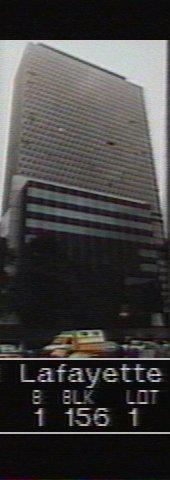
The city photographed every building for its tax records around 1940 and again in the 1980s. NYC Municipal Archives.
Written with AI from the source each entry cites, then fact-checked.
- 1826
Freemasons lay the cornerstone of a Gothic Masonic Hall on the future site of the tower
An earlier building stood here: a Gothic-style Masonic Hall whose cornerstone was laid on June 24, 1826, on Broadway between Reade and Pearl Streets, facing the original New York Hospital. The $50,000 building's main hall was modeled on Henry VII's chapel at Westminster Abbey, and it held what was then the world's largest bowling alley. It was the Grand Lodge of New York's home until it was demolished in 1856.
“…the cornerstone was laid for a Gothic style Masonic Hall on Broadway ... between Reade and Pearl Streets ... today the location of the Jacob K. Javits Federal Building.”
Source: Wikipedia
- 1958
The federal government picks a site west of Foley Square for its biggest building outside Washington
In November 1958 the General Services Administration announced the site for what would be the largest federal building outside the Washington area. About 25 smaller buildings had to be demolished for it. The project belonged to a wider redevelopment of Lower Manhattan in the 1950s and 1960s, pushed by David Rockefeller as chairman of the Downtown-Lower Manhattan Association, which culminated in the World Trade Center.
Source: gsa.gov
- 1967
The 41-story tower is finished in a checkerboard of limestone, granite and glass
The 41-story tower was completed in 1967 with little ornament, its walls an irregular checkerboard of gray Alabama limestone, black Minnesota granite and glass. A taller 45-story annex by the original architects was later attached on the west side. Pale vertical members run the full height of the facade, and the entrance is recessed behind piers, with a marble main lobby and terrazzo floors.
Source: gsa.gov
- 1969
A bomb planted by Sam Melville explodes in the Federal Office Building on Federal Plaza
A bomb exploded in the Federal Office Building on Federal Plaza on September 19, 1969, in space occupied by the Department of Commerce and the Army Inspector General. It was one of eight 1969 bombings of Manhattan government and commercial buildings by Sam Melville, who cited opposition to the Vietnam War. Most were preceded by warning calls. Melville pleaded guilty to this bombing and other charges, and was killed in the 1971 Attica uprising.
“Sep 19, Federal Office Building on Federal Plaza, offices of the Department of Commerce and the Army Inspector General…”
Source: Wikipedia
- 1981
The tower is named for Senator Jacob Javits, who had requested its federal funding
GSA dates the naming of the Jacob K. Javits Federal Building to 1981. Javits, a New Yorker born in 1904, entered politics in 1947 when he was elected to Congress, later served as state attorney general and then held a Senate seat for four terms. As a senator he asked for the federal money for the building that came to carry his name. He died in 1986.
Source: gsa.gov
- 1981
Richard Serra installs Tilted Arc, a 120-foot steel wall that cuts the plaza in half
In 1981 Richard Serra's Tilted Arc went up in the plaza in front of the building, commissioned through the General Services Administration's Arts-in-Architecture program at a cost of $175,000. The sculpture was a curving raw-steel wall, 120 feet long and 12 feet high, that split the plaza and made office workers walk around it. It drew complaints at once, and Judge Edward Re began a letter-writing campaign to have it removed.
Source: pbs.org
- 1985
A public hearing on Tilted Arc draws 180 witnesses, with 122 speaking to keep it
In March 1985 a public hearing was held on whether to remove Tilted Arc. Of those who testified, 122 wanted it kept and 58 wanted it gone. Philip Glass, Keith Haring and Claes Oldenburg spoke in its favor, while workers from nearby offices argued for removal. A jury of five voted 4 to 1 to take it out, and Serra sued the General Services Administration the next year.
“…with 122 people testifying in favor of keeping the piece and 58 in favor of removing it…”
Source: Wikipedia
- 1988
Former President Richard Nixon says he will leave his federal office here after eight years
On September 20, 1988, aides said Richard Nixon would give up the federal office he had kept at 26 Federal Plaza for eight years. His chief aide, John Taylor, said the trip from Nixon's home in Saddle River, New Jersey, was taking him as much as two hours each way. Nixon had also ordered that the rent at the new suite, in Woodcliff Lake, not exceed what staying put would cost, though Taylor said it would run a bit more.
Source: upi.com
- 1989
Federal workers cut Tilted Arc into three pieces overnight and haul it away
After Serra's appeal failed, workers dismantled Tilted Arc during the night of March 15, 1989. They cut the 120-foot steel wall into three pieces and carried it out of the plaza. Serra had testified that the sculpture was made for the site, so removing it would destroy it. The decision set off a wider national debate over public art, artists' rights and the public's role in judging art.
Source: pbs.org
- 1997
Martha Schwartz's bright redesign replaces the steel wall with grassy mounds and green benches
After Tilted Arc was removed, the General Services Administration hired landscape architect Martha Schwartz to redesign Foley Square Plaza. Her plan, completed in 1997, added six-foot grassy hemispheres, serpentine green benches around them, spiral handrails and orange mesh trash cans. A second renovation, designed by WASA/Studio A with Michael Van Valkenburgh Associates, was completed in 2013 after funds were set aside to fix the leaking garage below.
Source: gsa.gov
- 2025
Federal officers arrest Comptroller Brad Lander and ten state lawmakers outside the 10th-floor holding cells
On September 18, 2025, after an hour-long standoff in the hallway outside the immigration holding cells on the 10th floor, Department of Homeland Security officers arrested 11 elected officials who had demanded access: city Comptroller Brad Lander, three state senators and seven Assembly members. They were released within the hour with tickets for obstructing entrances. A federal judge had ordered minimum conditions for the cells the day before. DHS said Lander had arrived unannounced with media and obstructed law enforcement.
Source: thecity.nyc
Further reading
- 26 Federal PlazaWikipedia
Nearby
- 319 Broadway (one of the Thomas Twins)319 Broadway | 7 entries
- 315 Broadway Building315 Broadway | 8 entries
- 311 Broadway Building311 Broadway | 12 entries
- 325-333 Broadway Building325 Broadway | 12 entries
- Ted Weiss Federal Building290 Broadway | 15 entries
- James L. Watson U.S. Court of International Trade Building1 Federal Plaza | 6 entries