Ted Weiss Federal Building
290 Broadway | Civic Center | built 1994
Open on the map15 entries

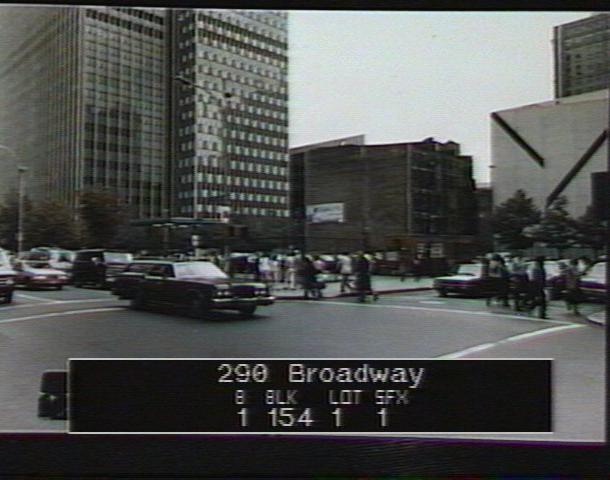
The city photographed every building for its tax records around 1940 and again in the 1980s. NYC Municipal Archives.
Written with AI from the source each entry cites, then fact-checked.
- 1827
Rutgers Medical College occupies two lots at what is now 80 Duane Street
Long before the federal tower, the Rutgers Medical College held two lots at the future 80 Duane Street address, on part of the site the Weiss Building now covers. The college stayed there from 1827 until the late 1830s. A Federal-era brick dwelling at 80 Duane Street stood until 1920.
- 1897
The 15-story R.G. Dun Building rises at 290-294 Broadway, among the last buildings on the lot before the tower
The Broadway end of the block held several commercial buildings before the federal tower. They included the R.G. Dun Building, fifteen stories high and dated 1897, at 290-294 Broadway, and a ten-story building from 1898 at 296 Broadway. A McKim, Mead and White building at 298 Broadway was combined with its neighbor at 300 and heightened to ten stories, and the sixteen-story Vincent, later the Fordham Building, stood at 302-304. All were demolished in the late 1960s and late 1970s.
- 1987
Congress authorizes two federal buildings near Foley Square, including the one at 290 Broadway
An omnibus spending bill signed by President Ronald Reagan in December 1987 authorized the General Services Administration to build a courthouse and an office building at 290 Broadway. Congress provided no money, so private developers had to raise the funds, and the GSA would lease each building for 30 years before taking ownership. The city, which owned the 290 Broadway site, would lease 400,000 square feet there at a reduced rate for handing the land to the federal government.
“The GSA was authorized to construct two structures near Foley Square, Manhattan, as part of an omnibus spending bill signed by U.S. president Ronald Reagan in December 1987.”
Source: Wikipedia
- 1989
A cultural resource survey of the Republican Alley area precedes construction
A Stage 1A Cultural Resource Survey of the area around Republican Alley was completed in 1989, before construction began in 1991 on a 34-story federal office tower at 290 Broadway. Federally funded construction projects must comply with Section 106 of the National Historic Preservation Act of 1966.
Source: National Park Service
- 1991
Excavation for a federal tower uncovers the African Burial Ground
On October 8, 1991, workers digging the foundation for a federal office building at 290 Broadway found intact human burials. They were part of a colonial cemetery where enslaved and free Africans were buried. After community protests in 1992, Congress halted the project. In all, 419 remains were removed and studied by a team at Howard University led by the physical anthropologist Michael Blakey.
Source: Wikipedia
- 1992
Chinatown protesters say few Asian-American firms and workers have a place on One Foley Square
At a protest in July 1992, demonstrators from Chinatown charged that only two of the fifty-two firms working on the project, then called One Foley Square, were Asian-American, and that no Asian-American workers were employed on it. They asked that at least 30 percent of the workforce be Asian. Developer Linpro denied discrimination and offered contracts to several Asian-run businesses; by November 1992 it had passed $64 million in subcontracts to 63 local firms classed as small or disadvantaged.
Source: Wikipedia
- 1993
The African Burial Ground is designated a National Historic Landmark
The remains found during construction lay about 30 feet below the modern street. They belonged to a burial ground of roughly six acres where, according to the National Park Service, upwards of 15,000 enslaved and free Africans were buried between the middle 1630s and 1795. The site was designated a National Historic Landmark in 1993, and an outdoor memorial, an interpretive center and a research library were later built to honor the people buried there.
Source: National Park Service
- 1993
The Landmarks Commission designates the African Burial Ground and The Commons Historic District
On February 25, 1993, the Landmarks Preservation Commission designated the African Burial Ground and The Commons Historic District, whose report describes the tower site at 290-304 Broadway among its properties. At the September 1, 1992 public hearing, 53 people testified in favor, including Mayor David N. Dinkins and Congressman Charles Rangel.
- 1994
Roger Brown's glass mosaic and The New Ring Shout are installed at the Federal Office Building
In 1994 the facade gained an untitled glass mosaic by Roger Brown beside the African Burial Ground, 14 feet high and 10 feet wide, showing the Brooklyn Bridge, the Twin Towers and the Empire State Building above a grid of faces that turn into skulls toward the bottom. Inside, the rotunda floor holds The New Ring Shout, a 40-foot terrazzo-and-brass circle by Houston Conwill, Joseph De Pace and Estella Conwill Majozo, named for the ring shout dance.
“An untitled mosaic by Roger Brown, next to the African Burial Ground's Outdoor Memorial, was installed on the facade in 1994.”
Source: Wikipedia
- 1994
A federal office tower opens over the newly found burial ground
Congress authorizes construction of a new federal office tower at Foley Square in a 1987 spending bill signed by President Reagan, and the General Services Administration awards $700 million in contracts for the project in March 1991. Construction of the $276 million building begins that year and finishes in 1994, on the same block where excavation had just uncovered the African Burial Ground.
Source: Wikipedia
- 1998
Barbara Chase-Riboud's Africa Rising and Tomie Arai's Renewal are installed in the lobby
In 1998 the lobby received Africa Rising, a bronze sculpture by Barbara Chase-Riboud, 15 feet 5 inches tall, themed to the struggles of slaves in the United States. It also received Renewal, a silk-screened mural by Tomie Arai, 7.5 by 38 feet, with overlapping images of 18th- and early 19th-century American history designed to evoke the process of archeological excavation.
“The building's lobby contains Africa Rising by Barbara Chase-Riboud, a bronze sculpture installed in 1998.”
Source: Wikipedia
- 2003
The 419 ancestors are reburied at the African Burial Ground
On October 4, 2003, the remains of 419 people were reinterred beside the federal building in hand-carved wooden coffins lined with kente cloth, set in burial mounds. President George W. Bush designated the site a national monument on February 27, 2006, a memorial by Rodney Leon and Nicole Hollant-Denis was dedicated on October 5, 2007, and a visitor center opened in the federal building on February 27, 2010.
Source: Wikipedia
- 2003
The tower is renamed for Congressman Ted Weiss
In April 2003 the General Services Administration renames the Foley Square office tower the Ted Weiss Federal Building, honoring the Democratic congressman from New York who lived from 1927 to 1992. The renaming comes a decade after the site's African Burial Ground was designated a National Historic Landmark.
Source: Wikipedia
- 2007
An outdoor memorial to the African Burial Ground is dedicated
Designers Rodney Leon and Nicole Hollant-Denis, chosen in 2005 to create a memorial, see its outdoor portion dedicated in 2007 at the foot of the federal building. An indoor visitor center telling the burial ground's story opens inside the building itself in February 2010.
Source: Wikipedia
- 2010
The African Burial Ground visitor center opens in the Weiss Building's lobby
The visitor center for the African Burial Ground National Monument opened in the building itself in February 2010. The GSA had chosen a consortium of African American architects for the lobby exhibition space in March 2000, and in April 2005 it picked the outdoor memorial design by Rodney Leon and Nicole Hollant-Denis. In 2006 the government announced an $8 million memorial including a $5 million visitors' center.
“…the visitor center in the building itself opened in February 2010…”
Source: Wikipedia
Further reading
- Ted Weiss Federal BuildingWikipedia
Nearby
- 22 Reade Street (City Planning Building)22 Reade Street | 4 entries
- Sun Building280 Broadway | 11 entries
- Jacob K. Javits Federal Building26 Federal Plaza | 11 entries
- 49 Chambers (Emigrant Industrial Savings Bank Building)49 Chambers Street | 13 entries
- 311 Broadway Building311 Broadway | 12 entries
- Mutual Reserve Building305 Broadway | 9 entries