289 Church Street
Tribeca | built 1868
Open on the map4 entries

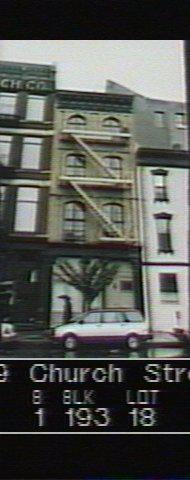
The city photographed every building for its tax records around 1940 and again in the 1980s. NYC Municipal Archives.
Written with AI from the source each entry cites, then fact-checked.
- 1864
Police raid a policy shop in the rear yard of the house that stood on the site of 289 Church Street
Before the present building, a two-story house at what was then 195 Church Street stood here, with a smaller structure in its rear yard. On April 20, 1864, Police Captain Petty raided Joseph Lewis's policy shop there and seized a wheel used to draw gambling numbers. No games were being played, so no one was arrested. This was an earlier building on the site.
Source: Daytonian in Manhattan
- 1868
Charles Duggin designs an unusual Second Empire store and loft for Moses Ely
Duggin's building of 1867-68 stands on an unusually shallow lot 21 feet wide and replaced a two-story building. It has a cast-iron base, a sandstone upper facade, and window openings of varied shapes with prominent keystones. A lawyer named Moses Ely practiced in New York from 1859 to 1883, and the owner may have been that man; his heirs kept the property into the 1920s.
- 1899
Jacob Ruppert, the brewer, takes over the ground-floor saloon at 289 Church Street
The ground floor was a saloon for decades, with Henry Murken running it as a beer saloon by 1885 and adding liquors by 1890. After two other leaseholders, Jacob Ruppert, owner of one of Manhattan's major breweries, took the space in 1899. Breweries often ran their own saloons so they could sell only their own brands, and Ruppert's stayed into the early 1900s.
Source: Daytonian in Manhattan
- 2006
Artist Steven Rand turns his Church Street studio building into a kinetic work of art
In the early 2000s the building was the studio of its owner, the artist Steven Rand. In fall 2006 he transformed the structure itself into an artwork. After dark, its windows changed colors one at a time in pulsing patterns, so the whole facade worked as a kinetic piece.
Source: Daytonian in Manhattan
Further reading
- The Striking 1868 289 Church StreetDaytonian in Manhattan
Nearby
- apexart291 Church Street | 5 entries
- 34 White Street5 entries
- 36 White Street6 entries
- 293 Church Street4 entries
- 38 White Street1 entry
- 295 Church Street5 entries