34 White Street
also 285 Church Street | Tribeca | built 1804
Open on the map5 entries

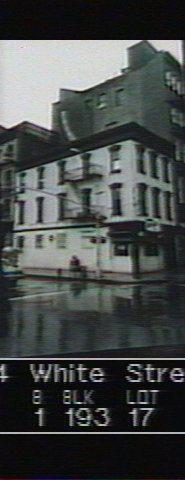
The city photographed every building for its tax records around 1940 and again in the 1980s. NYC Municipal Archives.
Written with AI from the source each entry cites, then fact-checked.
- 1853
Grocer Gerhard Dieckman spots two men trying to pass a counterfeit bank bill at his store
By 1851 the ground floor of this corner house was a grocery, and in 1853 it was run by Gerhard Dieckman, who lived upstairs. That August a Fifth Ward officer arrested Charles King and Thomas Brooks, accused of trying to pass a counterfeit bank bill at the store. The New-York Daily Tribune reported the arrests on August 18.
Source: Daytonian in Manhattan
- 1877
William Watson remakes a c. 1805 frame house at White and Church as a three-story neo-Grec building
This corner building began as a two-story frame dwelling, built around 1805 or earlier, where Abraham Moore lived for several years. In 1876-77 the owner, dry-goods merchant William Watson, transformed it into a three-story building in the neo-Grec style. The landmarks commission records the lot as 25 feet along White Street and 55 feet along Church Street.
- 1903
Two detectives bet on a horse at a ticker-equipped saloon and arrest 24-year-old Edward Kusker
By 1903 the ground floor was a saloon, and detectives Delaney and Rice got a tip that a horse-race handbook operated there. In the first week of May, Delaney sat by a ticker in the corner, placed a bet with a marked two-dollar bill on Early Eve in the sixth race, and the operator, 24-year-old Edward Kusker, accepted it. Police described his operation as a gigantic gambling business, and he was arrested.
Source: Daytonian in Manhattan
- 1907
Stationer Levi Richardson's love-letter scandal precedes his bankruptcy
In 1904 Levi Y. Richardson, described as a wealthy stationer, installed the Ryan Stationery Company in the renovated building. In April 1907 his wife Mary found two love letters in his pockets, and by June newspapers reported her suit for separation alleging cruelty and abandonment. That summer Richardson filed for bankruptcy, and Cornelius Steers took over the stationery firm at the address.
Source: Daytonian in Manhattan
- 1994
The Baby Doll Lounge fills the ground floor, drawing Tribeca hipsters
As Tribeca turned fashionable, the ground-floor space once used by Edward Kusker's saloon became the Baby Doll Lounge. On August 22, 1994 New York Magazine described Tribeca hipsters slumming there, and the bar stayed into the 2000s. In 1997 the upper floors became apartments, one per floor, and the restaurant Petrarca opened at street level on February 1, 2006.
Source: Daytonian in Manhattan
Further reading
- 200 Years of History - 34 White StreetDaytonian in Manhattan
Nearby
- 36 White Street6 entries
- 289 Church Street4 entries
- apexart291 Church Street | 5 entries
- 40 White Street5 entries
- 38 White Street1 entry
- 293 Church Street4 entries