apexart
291 Church Street | Tribeca | built 1877
Open on the map5 entries

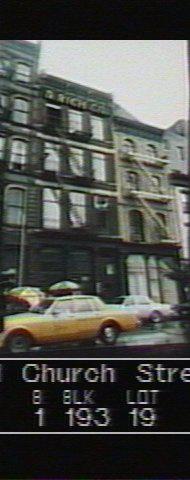
The city photographed every building for its tax records around 1940 and again in the 1980s. NYC Municipal Archives.
Written with AI from the source each entry cites, then fact-checked.
- 1845
Naomi Vreeland buys the frame house that stood here and opens a bordello
Before the present building, a wood-frame house stood on this lot. A chronology prepared for apexart's 1999 exhibition Building Histories says it was a boarding house from the 1820s and combined boarding with a public restaurant in the 1830s. In 1845 the widow Naomi Vreeland bought it with her inheritance and opened a bordello, which the chronology says carried on under an alias after a police raid in 1850.
Source: apexart.org
- 1877
John B. Snook designs a four-story neo-Grec store and loft for Henry G. Muller
Read more
In 1877 the architect John B. Snook, who designed many commercial buildings in Tribeca and SoHo, replaced a frame building here with a four-story neo-Grec loft for Henry G. Muller. Muller was probably the grocer and later liquor merchant of that name on nearby White Street, the Landmarks Preservation Commission says. J.R. & J.M. Cornell made the cast-iron storefront, and the original address, No. 197, is still marked on the building.
“Designed by John B. Snook, a prominent architect who was responsible for many commercial buildings in the Tribeca and SoHo areas…”
- 1925
Sponge importers move in, followed by carbon-products firms and a dust-mask company
A chronology prepared for apexart's 1999 exhibition lists a run of unusual tenants. In 1925 George A. Muller and Emma Muller sold the building to Henry and Minnie Koener, who began importing sponges there, and sponge and chamois firms occupied it into the late 1940s. From 1949 D. Rich & Co. appears in the listings, followed in the 1950s by firms named Carbon & Graphite Products and Seager Carbon, with Martindale Dust Masks listed in the 1960s.
Source: apexart.org
- 1994
Steven Rand founds apexart, a non-profit art space based at 291 Church Street
Steven Rand founded apexart in 1994 as a non-profit art space in Lower Manhattan. It is known for open calls in which hundreds of jurors around the world vote on anonymously submitted exhibition proposals; winners receive a $10,000 budget, $2,000 of it a stipend. Nine exhibitions a year are held in its Tribeca space at 291 Church Street or at temporary venues abroad.
“The organization, founded by Steven Rand in 1994, combines spaces for creative endeavor and curation to encourage experimentation and innovation.”
Source: Wikipedia
- 1999
apexart opens Building Histories, an exhibition about the history of 291 Church Street
On October 14, 1999, apexart opened Building Histories, curated by the artist Maureen Connor, with work by Haim Steinbach, Martha Wilson, David Wells, the group REPOhistory and others responding to the building's past. The show ran to November 13 and came with a chronology of the lot stretching from colonial farmland to the 1990s, drawing on books by Eric Homberger and Timothy Gilfoyle and a 1973 report on Tribeca. Related programs included a slide series by David Wells on Tribeca's lighting fixtures.
Source: apexart.org
Nearby
- 289 Church Street4 entries
- 293 Church Street4 entries
- 295 Church Street5 entries
- 38 White Street1 entry
- 36 White Street6 entries
- 34 White Street5 entries