36 White Street
Tribeca | built 1880
Open on the map6 entries

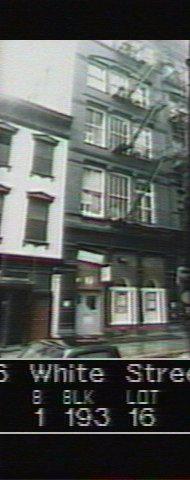
The city photographed every building for its tax records around 1940 and again in the 1980s. NYC Municipal Archives.
Written with AI from the source each entry cites, then fact-checked.
- 1821
R. Tagart's School operates in a house that stood on the lot before the loft building
Before the present building, an older house stood at 36 White Street, when the neighborhood was almost entirely residential. As early as 1821 a school, R. Tagart's School, operated from that house. In 1880 dry goods magnate Seth Milliken bought the converted vintage house and hired an architect to replace it.
Source: Daytonian in Manhattan
- 1880
J. Morgan Slade designs a five-story neo-Grec loft for dry goods merchant Seth Milliken
The 25-foot-wide, five-story store and loft building was erected in 1880 for Seth M. Milliken (1836-1920), a major cotton and woolen manufacturer and bank director, to designs by J. Morgan Slade. It replaced two small buildings, a frame one at the front of the lot and an industrial structure behind. The facade is in the neo-Grec style, with a four-story brick upper section above the storefront.
“…erected in 1880 and replaced two small buildings, a frame structure at the front of the lot and a rear structure used for industrial purposes.”
- 1892
Trimmings dealer Nathan Cohen's feud with his wife ends his business
Nathan Cohen sold trimmings here until money troubles in 1891, after he had signed his properties over to his wife and she refused to give them back. He then filed complaints about her tenements with the health, fire and building departments. The New York Times reported that she once thrashed him with a broom after finding him taking the silverware to pawn. His business failed in 1892.
Source: Daytonian in Manhattan
- 1904
The Art Fabric Company sells a 2.5-foot cloth doll with printed clothes for 50 cents
The Art Fabric Co., textile designers in the building, introduced a Christmas item in 1904: a life-size cloth doll whose clothes were printed on the fabric. It stood two and a half feet tall, came with shoes that could be put on and taken off, and sold for 50 cents. A New-York Tribune advertisement of December 11 promoted it as having no clothes to ruin or lose.
Source: Daytonian in Manhattan
- 1922
Prohibition agents raid a linen firm at 36 White Street and seize over $500,000 in liquor
Linen dealer Watts-Stebbins and Company leased all the lofts in 1919, shortly before Prohibition began. According to the New-York Tribune on September 17, 1922, agents raided the four floors and seized liquor valued at more than $500,000. An undercover agent had earlier bought six bottles of whisky for $30 from clerk Joseph Elliott.
Source: Daytonian in Manhattan
- 1975
Architects wear costumes of Lower Manhattan buildings in a parade, including 36 White Street
In June 1975 the City Planning Commission proclaimed Lower Manhattan on Exhibit Month to celebrate the area's architecture. One event was a fashion show in which architects and artists wore costumes made to look like famous buildings. The New York Times described the show on June 19, and 36 White Street was among the structures represented. The building was converted to apartments, one per floor, in 1981.
Source: Daytonian in Manhattan
Further reading
- J. Morgan Slade's 1880 36 White StreetDaytonian in Manhattan
Nearby
- 34 White Street5 entries
- 289 Church Street4 entries
- 40 White Street5 entries
- apexart291 Church Street | 5 entries
- 38 White Street1 entry
- 42 White Street2 entries