Nicholas Roerich Museum
319 West 107th Street | Upper West Side | built 1898
Open on the map9 entries

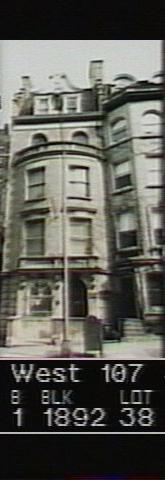
The city photographed every building for its tax records around 1940 and again in the 1980s. NYC Municipal Archives.
Written with AI from the source each entry cites, then fact-checked.
- 1898
Clarence True gives the westernmost house on the row a side wall full of windows
Clarence True designed No. 319 as the westernmost house of its row, where an easement beside the vacant corner lot let light in on three sides. He filled the exposed side with windows of varied sizes and shapes, including a third-story oriel and, near the rear, a bowed bay two stories tall. Flemish Revival stepped gables and an elaborate three-bay dormer with a curved, broken pediment and a carved shell completed the design.
Source: Daytonian in Manhattan
- 1900
Developer Charles Buek sells the new West 107th Street rowhouse
Buek, who had commissioned architect Clarence F. True to design a row of houses across from his other Upper West Side projects, sells the finished house at No. 319 to Edith Hoge and other investors as a rental property. An ad for the row had touted it as offering "a city house with country surroundings."
Source: Daytonian in Manhattan
- 1917
The Vickers family, who ran a Fifth Avenue gown firm, all file for bankruptcy within weeks
Austin and Mary Vickers were living at 319 West 107th Street when they founded Vickers Et Cie, a gown business at 546 Fifth Avenue, in 1912. It was incorporated with Mary as president on April 1, 1916. The company filed for bankruptcy on January 31, 1917, Austin filed personally 21 days later, and Mary filed the next day, ending the Vickerses' time in the house.
Source: Daytonian in Manhattan
- 1923
A summer tenant strips lyricist Harry B. Smith's house of its stove, furs and picture frames
In 1923 Harry B. Smith leased his house for the summer for the first time, to Jessie Jacobson, who paid four months' rent at $300 a month. In September she mailed back the key and left, taking the kitchen stove, a gas range, baby carriages, fur coats, rugs and picture frames worth about $2,000. Detectives found everything in a Richmond Hill warehouse, and Smith vowed never to lease the house again.
Source: Daytonian in Manhattan
- 1936
Lyricist Harry B. Smith dies after two decades in the house
Smith, a prolific Broadway lyricist and librettist, had lived at 319 West 107th Street with his wife, actress Irene Bentley, through the 1920s and into the 1930s. He dies at age 75 while staying at a hotel in Atlantic City, closing out a residency that predates the building's later life as a museum.
Source: Daytonian in Manhattan
- 1940
Actress Irene Bentley leaves for her New Jersey house and never returns to West 107th Street
After Harry B. Smith died in 1936, his widow Irene Bentley, a musical comedy star on the New York and London stages until she retired in 1910, stayed on alone in the house. She left in January 1940 for the couple's Allenhurst, New Jersey, house and never came back to the city. She died there that June, at the age of 70.
Source: Daytonian in Manhattan
- 1949
The Nicholas Roerich Museum opens in a brownstone on West 107th Street
The Russian-born painter's work had been shown in the Master Building on Riverside Drive until his patron Louis Horch took control of it in 1938 and removed the paintings from view. In 1949, two years after Roerich's death, a new Nicholas Roerich Museum opened in this brownstone at 319 West 107th Street. It still exhibits his work and may be the only museum in New York devoted to a single artist.
Source: Ephemeral New York
- 1953
The Buildings Department caps music and art lessons at the Fosdick family's house
Dudley Fosdick, a Columbia graduate who played with Guy Lombardo's band for thirteen years, had converted the house by 1950 to allow family members to teach music and art. By 1953 the family lived on the first and fourth floors, with a reception and music room on the second and library and painting rooms on the third. City inspectors limited the house to two outside instructors and ten pupils.
Source: Daytonian in Manhattan
- 1957
Roerich Museum director Dudley Fosdick dies
Fosdick, who had directed the Nicholas Roerich Museum after its move to the West 107th Street brownstone, dies at the house. His tenure had followed the museum's earlier years inside the Master Apartments on Riverside Drive, before it settled permanently into the townhouse in 1949.
Source: Daytonian in Manhattan
Further reading
- Nicholas Roerich MuseumWikipedia
- The Roerich Museum House -- No. 319 W. 107th StreetDaytonian in Manhattan
- Nicholas Roerich MuseumPlace Matters
Nearby
- Schinasi House351 Riverside Drive | 11 entries
- The Manhasset301 West 108th Street | 8 entries
- Canavan Mansion333 Riverside Drive | 4 entries
- Charles de Cordova House312 West 105th Street | 6 entries
- Harmony Hall544 Cathedral Parkway | 6 entries
- Master Building310 Riverside Drive | 13 entries