Kingsland Buildings
315 Church Street | also 38 Lispenard Street, 317 Church Street | Tribeca | built 1869
Open on the map5 entries

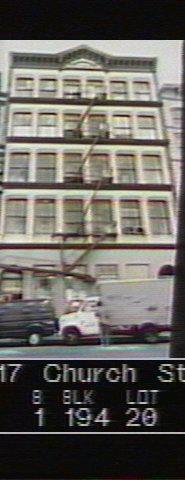
The city photographed every building for its tax records around 1940 and again in the 1980s. NYC Municipal Archives.
Written with AI from the source each entry cites, then fact-checked.
- 1867
Attorney Daniel C. Kingsland builds a cast-iron loft building with two matching facades
Daniel C. Kingsland (1812-1881), an attorney, bank director and patron of the Academy of Music, had Isaac F. Duckworth design this L-shaped Second Empire building in 1866-69 on the site of several small dwellings. It has near-twin cast-iron facades on Church and Lispenard Streets, marked 1867. Early occupants included shirt and hosiery makers Oakley, Steele & Company and J. R. Leeson & Company, a large linen-thread importer.
- 1888
Cloak makers McCoun & Lee show a line of garments they call blouses
McCoun & Lee, cloak manufacturers listed in directories as makers of cardigan jackets and jerseys, moved here around 1884 and ran 50 sewing machines. A 1917 trade review traced the word blouse in American clothing to the firm, noting that a line of them was first shown by McCoun & Lee in 1888 at 315 Church Street. Even then, shirtwaist and waist were the more common terms.
Source: Daytonian in Manhattan
- 1905
Striking garment workers from Edelson & Shipiro storm a rival factory and 25 are arrested
In 1905 fifty employees of the cloak makers Edelson & Shipiro went on strike; they belonged to the United Garment Workers of America. When Max Lacher, a Canal Street manufacturer, filled some of the firm's orders, the strikers stormed his factory on July 20. Police from the Leonard Street station arrested twenty-five of them on a charge of rioting, while the rest escaped over fire escapes and rooftops.
Source: Daytonian in Manhattan
- 1915
The Plato Art Co. markets the "Mirrored Hand" driving-glove mirror
In 1915 the building housed the Caledonian Publishing Co., which produced books and a family magazine, and the Plato Art Co., a printer best known for wall calendars and almanacs. Plato also brought out the "Mirrored Hand," a mirror worn on the back of a driving glove so a motorist could glance behind by raising the hand. Mounting a mirror on the car frame worked better, and the invention was short-lived.
Source: Daytonian in Manhattan
- 1917
William E. Wright & Sons, the bias-tape maker, takes four floors
William E. Wright started out selling cut fabric door to door and then invented bias tape, which became a staple for clothing makers. He opened a store in 1897, and by 1917 his firm leased all four floors above the storefront at 315 Church Street, having moved from 40 Lispenard Street around the corner. It also published a pamphlet showing uses for bias tape.
Source: Daytonian in Manhattan
Further reading
- The 1867 Kingsland Building - 315 Church Street Daytonian in Manhattan
Nearby
- 319 Church Street5 entries
- 40 Lispenard Street2 entries
- 313 Church Street3 entries
- 42 Lispenard Street2 entries
- 311 Church Street2 entries
- 44 Lispenard Street5 entries