Verizon Building
32 Avenue of the Americas | also 316 Church Street, 16 Walker Street | Tribeca | built 1914
Open on the map11 entries

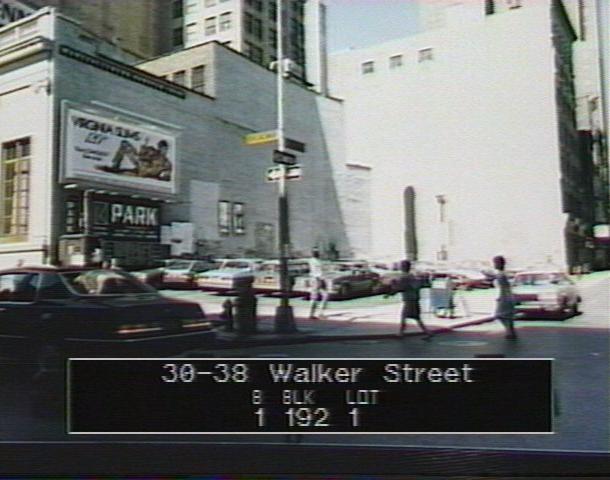
The city photographed every building for its tax records around 1940 and again in the 1980s. NYC Municipal Archives.
Written with AI from the source each entry cites, then fact-checked.
- 1909
The telephone company buys a row of Walker and Lispenard Street buildings for its new headquarters
In 1909 New York Telephone assembles its site on the block by buying store-and-loft buildings at 18-24 Lispenard Street and 18-24 Walker Street, plus a three-story masonry dwelling at 26 Walker Street. The block had been part of the Lispenard family farm until streets were laid out in the early 1800s. The older buildings are torn down for the 17-story Walker Lispenard Building, built in 1911-14.
- 1910
Union N. Bethell becomes AT&T vice president and commissions the Walker Lispenard Building
Bethell, an Indiana native who began with the Bell System in Brooklyn in 1889, becomes vice president of AT&T in 1910 and orders the building through New York Telephone. As the city's telephone chief he had cut rates and doubled pay stations; the number of phones in New York rose from 10,000 in 1893 to 310,000 about fifteen years later. He died in 1919.
“Bethell was made vice president of AT&T in 1910 and concurrently commissioned the Walker Lispenard Building through New York Telephone.”
- 1914
Two months after opening, the telephone company files to add seven more stories
The long-distance central office goes into service in January 1914, and two months later an alteration application is filed to raise the structure to 24 stories, because the foundations and steel skeleton had been designed to take more floors. The seven-story addition, finished before 1919, extends the original design. New York Telephone occupies floors 18 to 23, where it keeps two of its Manhattan central offices. The building serves as AT&T's largest long-distance office, with 1,470 switchboard and test board positions and 2,200 long-distance lines.
- 1914
New York Telephone completes one of the world's largest telephone buildings
New York Telephone completed the seventeen-story Walker-Lispenard Building in January 1914, designed by Cyrus L. W. Eidlitz with McKenzie, Voorhees & Gmelin. At a cost of about $1.4 million, it was built as one of the world's largest structures used solely for telephone operations.
Source: Wikipedia
- 1931
New streets cut away parts of the block before the telephone expansion
Two city projects reshape the block as the company plans its giant addition. A subway tunnel under Church Street and a 40-foot widening of the street lead to the demolition in 1931 of six buildings that stood on the west side of the street along this block. Sixth Avenue's extension south to White Street destroys the structures on the western third of the lot, and the small nineteenth-century buildings beside the 1914 tower are also cleared so the new wings can fill the site.
- 1932
The finished tower runs around the clock as a small city with dormitories and cafeterias
When Ralph Walker's expansion is done, about 5,500 workers staff a building that never closes. It has dormitories, a kitchen and three cafeterias on floors seven through nine, a 500-person auditorium, and a medical department. The passenger elevators grow from four to thirty-two, and the legal, personnel and publicity departments occupy the 27th story.
- 1932
Ralph Walker's Art Deco redesign creates the world's largest long-distance hub
Between 1929 and 1932, architect Ralph Thomas Walker rebuilt and expanded the telephone building in Art Deco style, raising it to twenty-seven stories and about 1.17 million square feet at a cost of roughly $6-7 million. On completion it housed what was billed as the world's largest long-distance communications hub.
Source: Wikipedia
- 1932
Hildreth Meière's lobby murals depict a world united by telephone wires
Artist Hildreth Meière, who also decorated St. Bartholomew's Church and Radio City Music Hall, created a mosaic mural for the building's lobby showing the continents and oceans beneath the phrase "telephone wires and radio unite to make neighbors of nations." A ceiling mural depicts four continents linked by gilded telephone lines.
Source: Forgotten New York
- 1991
The exterior and lobby are designated New York City landmarks
The Landmarks Preservation Commission designated the building's exterior and lobby New York City landmarks on October 1, 1991, recognizing Ralph Walker's Art Deco design. Rudin Management later bought the building from AT&T for about $150 million in 1999.
Source: Wikipedia
- 2010
Radio stations stage giveaway-ticket concerts in a 250-person theater off the lobby
By 2010 the P.C. Richard & Son Theater, a 250-capacity room off the lobby, hosts concerts about twice a week for the radio stations broadcasting from the tower. Acts have included John Legend, Bon Jovi, Justin Bieber, Mariah Carey, Shakira and Alicia Keys, and tickets go only to promotion winners. A reporter attending a Duffy show finds a bare-bones box where the audience stands in the middle of the room.
Source: tribecacitizen.com
- 2023
Owner proposes a corner pavilion and new windows; Community Board 1 calls it heavy-handed
Rudin Management, with the building about 40 percent vacant, proposes a 640-square-foot, one-story triangular addition on the building's northwest corner, designed by Marvel, along with new entrances, glazing and signs on every side. Community Board 1 rejects the plan, calling it heavy-handed, and a landmarks hearing set for October 31 is postponed. The board had also opposed changes to the bronze-and-glass entrance and lobby lighting the year before.
Source: tribecatrib.com
Further reading
- 32 Avenue of the AmericasWikipedia
- VERIZON BUILDING MURAL, TribecaForgotten New York
Nearby
- Canal Street Station Post Office350 Canal Street | 3 entries
- 34 Walker Street5 entries
- 319 Church Street5 entries
- 313 Church Street3 entries
- 311 Church Street2 entries
- Kingsland Buildings315 Church Street | 5 entries