Alfred S. Seer House
37 Charles Street | West Village | built 1869
Open on the map5 entries

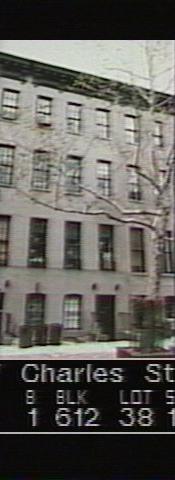
The city photographed every building for its tax records around 1940 and again in the 1980s. NYC Municipal Archives.
Written with AI from the source each entry cites, then fact-checked.
- 1869
James S. Bearnes builds two Italianate groups of houses, probably designed by Peter L. P. Tostevin
In 1868 James S. Bearnes of Brooklyn bought nearly all the vacant lots along the north side of Charles Street, running from West Fourth Street to what is now Waverly Place. He put up two groups of houses there, probably designed by the Brooklyn architect Peter L. P. Tostevin. Completed in 1869, they have Italianate high stoops leading to arched entrances under pediments on scrolled brackets, and each has a pressed-metal cornice. This house was then No. 49; the street was renumbered in 1936.
Source: Daytonian in Manhattan
- 1869
Theatrical printer Alfred S. Seer buys the new house, then leases it to an editor's family
Alfred S. Seer ran a theatrical printing and engraving firm on Union Square that specialized in playbills and handbills. After a year in the house, he and his family moved to 19 Perry Street, and the house was leased to the family of the editor and journalist George H. Stout, whose sons were a reporter at the New York Daily Transcript and a clerk. The Stouts rented through 1877, after which the Seers moved back and stayed into the 1880s.
Source: Daytonian in Manhattan
- 1887
The theatrical printer who owned the house sues the comedian Tony Hart over an unpaid bill
The Times reported on October 7, 1887 that Seer had sued the actor and singer Tony Hart and his wife to collect on printing done in the fall of 1885 for their play Buttons, which flopped and closed in January 1886. Seer was owed $2,773.63 and had received only $640. Hart, who had been half of the comedy team Harrigan & Hart until 1885, did not contest the suit because he had no property. Seer never recovered the money, and Hart died penniless in a mental institution in 1891, aged 36.
Source: Daytonian in Manhattan
- 1894
A boarder is accused of stealing a trunk of jewels in Springfield and is found at the house
William Virtue, a 32-year-old stenographer boarding here in 1894, took a train on February 6 with a traveling salesman, H. C. Barnum of the New York jewelry firm Schaefer & Douglas. In Springfield, Massachusetts, Barnum left his trunk in the baggage room overnight, and Virtue claimed it with a check, broke it open at his hotel under the name H. C. Boyd and sent $15,000 in gems by express to Worcester. Detectives traced the package, and a newspaper reported on February 11 that they had found Virtue at the Charles Street house the day before.
Source: Daytonian in Manhattan
- 2019
A restoration returns the house to a single-family home and rebuilds its lost stoop
By 1930 the house had been converted to apartments, its stoop removed and its molded lintels shaved flat. A restoration completed in 2019 brought it back to a single-family home. The architects Acheson Doyle & Partners rebuilt the stoop, entrance and lintels, working from surviving examples along the row.
Source: Daytonian in Manhattan
Further reading
- The 1869 Alfred S. Seer House - 37 Charles Street Daytonian in Manhattan
- Then & Now photos: 37 Charles StreetVillage Preservation: Greenwich Village Then & Now
Nearby
- 39 Charles Street3 entries
- Thomas Cudbirth House41 Charles Street | 5 entries
- 33 Charles Street1 entry
- 45 Charles Street1 entry
- The Carolus29 Charles Street | 3 entries
- Thomas H. Van Tine House47 Charles Street | 5 entries