Thomas Cudbirth House
41 Charles Street | West Village | built 1869
Open on the map5 entries

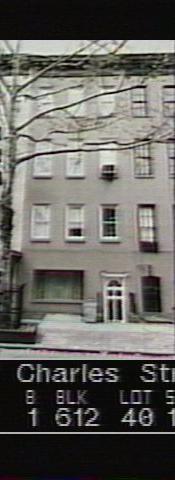
The city photographed every building for its tax records around 1940 and again in the 1980s. NYC Municipal Archives.
Written with AI from the source each entry cites, then fact-checked.
- 1869
Real estate developer Thomas Cudbirth buys one of five new Italianate houses and rents it out
A row of five three-story houses with bracketed cornices and arched doorway pediments was completed in 1869 on the north side of Charles Street between West 4th Street and Waverly Place. Thomas Cudbirth, a Village real estate dealer who lived a block away, bought the one then numbered 51, which was renumbered 41 in 1936. The first tenant was a merchant, Joseph R. Ferrer, who had served in the 74th Regiment of Infantry during the Civil War.
Source: Daytonian in Manhattan
- 1884
Thomas Cudbirth, a former sailor turned real estate agent, dies in the house
Cudbirth was born in 1806 and, after joining the Navy, spent 15 years at sea and was shipwrecked more than once before settling into real estate. He ran his business from the Charles Street house after his family moved in around 1874. When he died here, the New York Dispatch remembered him as a frank, rough-edged man with a kind heart who was a familiar figure in the Ninth Ward.
Source: Daytonian in Manhattan
- 1914
Scholar Samuel Augustus Binion, translator of the novel Quo Vadis, dies here
Binion, born in Suwalki, Poland, in 1837, studied at Breslau and Padua and worked as a reader at the British Museum for eight years. He later catalogued Oriental-language works at the Peabody Museum in Baltimore and was hired by Johns Hopkins University. He is chiefly known for translating Henryk Sienkiewicz's Quo Vadis, and he died in the house at age 77.
Source: Daytonian in Manhattan
- 1919
A proofreader living here is killed by a Seventh Avenue subway train
Frank J. Hopkins, who had been a proofreader at the New York American since 1909, lived in the house. On February 25, 1919, The Sun reported that a motorman felt a jar about 200 feet south of the Christopher Street station and found Hopkins's body under the first car of the train.
Source: Daytonian in Manhattan
- 2016
A renovation returns the former rooming house to a single-family home
The stoop was removed when the basement became a restaurant in 1933, which suggests the upper floors were then run as a rooming house. In 1960 the basement was made one apartment and each upper floor two. A renovation finished in 2016 made it a single-family home again, with the lost stoop and lintels recreated to restore the front to its 1869 look.
Source: Daytonian in Manhattan
Further reading
- The 1869 Thomas Cudbirth House - 41 Charles StreetDaytonian in Manhattan
- Then & Now photos: 41 Charles StreetVillage Preservation: Greenwich Village Then & Now
Nearby
- 39 Charles Street3 entries
- Alfred S. Seer House37 Charles Street | 5 entries
- 45 Charles Street1 entry
- Thomas H. Van Tine House47 Charles Street | 5 entries
- 49 Charles Street2 entries
- 33 Charles Street1 entry