40 Wall Street
Financial District | built 1930
Open on the map20 entries

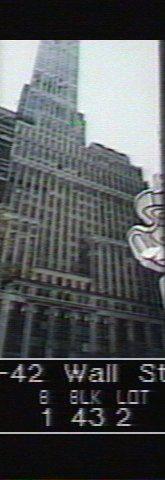
The city photographed every building for its tax records around 1940 and again in the 1980s. NYC Municipal Archives.
Written with AI from the source each entry cites, then fact-checked.
- 1799
Aaron Burr's Manhattan Company opens a bank in a rowhouse on this site
The Manhattan Company was organized in 1799 to give New York clean water after a yellow fever epidemic. Aaron Burr, then a Republican assemblyman and one of its founders, maneuvered a provision into the charter letting the company use capital above two million dollars for banking, despite the Federalist-led Bank of New York's opposition to any rival. The company took a site at 40 Wall Street and ran its office of discount and deposit from a rowhouse already standing there.
- 1929
Financier Ohrstrom assembles five parcels and announces a 47-story tower
George Ohrstrom's syndicate pieced together five parcels of office buildings on Wall and Pine Streets, then announced in March 1929 a 47-story tower by architect H. Craig Severance. Within weeks the Manhattan Company joined the scheme and leased its own parcel to the group for 93 years. The plan soon grew to more than 63 stories, aimed at topping both the Woolworth Building and the Chrysler Building then under construction.
- 1929
Architect H. Craig Severance lands the biggest commission of his career
Harold Craig Severance, born in Chazy, New York, began in 1900 in the office of his cousin, architect Charles A. Rich, and opened his own practice in 1907. From 1916 to about 1924 he was partnered with William Van Alen, who was called the firm's designer. The Manhattan Company Building was Severance's most important commission, and his firm at the time was styled H. Craig Severance, Inc., architects and engineers.
“…he was the partner of William Van Alen ... The Manhattan Company Building was Severance's most important commission…”
- 1929
Demolition and foundation work proceed side by side on a cramped Wall Street site
Builders began tearing down the old offices and building the foundations at once in early May 1929, since clearing the whole lot first would take too long. Bedrock lay 64 feet down beneath boulders and quicksand, and some old walls were five feet thick. Lighter footings were slipped under the existing foundations to help demolition and carry the first twenty stories, while heavier ones later took the full load, because caissons could not be used through the old masonry.
- 1929
A golden rivet is driven into one of the tower's eight great steel columns
At a July 1929 ceremony, a golden rivet was set in one of the tower's eight principal steel columns, which would bear the banking-floor trusses and, in effect, the whole building. The New York Times reported that each column, among the heaviest used in any American building, weighed about 22 tons and bore roughly 4.6 million pounds. Bethlehem Steel supplied the framework, which Levering & Garrigues erected.
“…a golden rivet was driven into one of the eight main steel columns…”
- 1930
The Bank of Manhattan Trust Building opens after a race with the Chrysler Building
Designed by H. Craig Severance with Yasuo Matsui, the tower went up in about a year, with workers finishing four stories a week, and topped out on November 13, 1929. At 927 feet it briefly claimed the title of world's tallest building, until the Chrysler Building raised a secretly built 125-foot spire to reach 1,046 feet. The Wall Street tower officially opened on May 26, 1930.
Source: Wikipedia
- 1930
A 71-story tower rises with modernized French Gothic detailing and 43 elevators
The finished building stood 927 feet and 71 stories. Its lowest six floors were faced in granite and limestone and set off by a classical colonnade suited to Wall Street, while the setbacks and tower above were buff brick with terra-cotta ornament. The roof stories held machinery, recreation space and an observation platform, and 43 high-speed elevators served the floors. Contemporary accounts described the detailing as modernized French Gothic.
- 1940
The tower is auctioned in foreclosure for nearly $11.5 million, a record bid
After the 1929 crash, the owners struggled for years to rent space and meet payments. By February 1940 Marine Midland Trust had replaced the 40 Wall Street Corporation as trustee of the bonds, and after a foreclosure in August the property was auctioned in September for nearly $11.5 million. It was the largest real estate auction bid on record to that point, placed on behalf of the bondholders. The second mortgage and the preferred and common stock, mostly held by Starrett interests, were wiped out.
“…in September the building was auctioned for nearly $11.5 million, the largest recorded real estate auction bid to that time…”
- 1944
40 Wall Street reaches full occupancy for the first time
After the Bank of Manhattan Trust Building opened into the depths of the Depression, only about half its office space stayed leased through the 1930s. The tower finally fills up in July 1944, as wartime demand for Manhattan office space and a recovering economy erase the vacancy that had plagued it since its 1930 opening.
Source: Wikipedia
- 1946
An Army transport plane crashes into the tower's 58th floor
On May 20, 1946, a military Beechcraft C-45F Expediter flying over Lower Manhattan struck 40 Wall Street at the 58th floor, causing significant damage to the tower. No one on the ground was injured. The building was then still known as the Bank of Manhattan Trust Building.
Source: Wikipedia
- 1959
Zeckendorf's Webb & Knapp completes its purchase of 40 Wall Street after a court-ordered auction
Real estate developer William Zeckendorf of Webb & Knapp bought the building's land leasehold and fee interests in a scheme he called the Wall Street Maneuver, meant to keep big banks downtown. When a minority shareholder sued after he acquired two-thirds of the stock, a court ordered an auction in October 1959, and Webb & Knapp finished the acquisition. The whole property had cost about $32 million, and the fee was sold to Metropolitan Life for $20 million in April 1960.
“In October 1959 the Manhattan Company Building was put up for auction as the result of a court order…”
- 1961
Manufacturers Hanover moves in after the ground story gets a new granite face
When Chase Manhattan built its own tower across Pine Street, Manufacturers Hanover Trust took over the base of 40 Wall Street as its downtown headquarters, staying about thirty years, from 1961 until its merger with Chemical Bank. Carson, Lundin & Shaw reworked the ground story in 1961-63, adding new granite veneer and black marble colonial-style doorways with paneled bronze doors. The original central entrance had been topped by a bronze Oceanus statue by Elie Nadelman.
- 1982
Ferdinand and Imelda Marcos secretly buy the 40 Wall Street leasehold
At the end of 1982 the building's leasehold was sold for seventy million dollars to an entity of the New York Land Company. The real buyers were the Philippine dictator Ferdinand Marcos and his wife Imelda, a fact first disclosed in 1985. Brothers Joseph and Ralph Bernstein of New York Land acted as the couple's real estate agents in the deal.
“The actual, secret owners of the leasehold were Philippines dictator Ferdinand Marcos and his wife Imelda…”
- 1986
A Philippine asset freeze leaves 40 Wall Street in limbo, once code-named Bridgetown
After Ferdinand Marcos fell, the Aquino government froze his assets within US banking channels in March 1986, leaving the building's future uncertain. Coded cables between the Marcos family and their alleged Manhattan front, Gliceria Tantoco, referred to 40 Wall Street as Bridgetown. In December Citicorp, which held a mortgage, signaled it would foreclose, and capital work, including upgrades to the unreliable elevators, was suspended while legal proceedings continued.
Source: Wikipedia
- 1989
A $77,000,100 bid wins the Marcos-linked leasehold by just $100
The Bernstein brothers won an August 1989 foreclosure auction at $108.6 million but could not pay the balance by the October 10 deadline, partly because of a bankruptcy proceeding in Curacao. At a second auction in November, Burton Resnick, representing Jack Resnick & Sons, offered $77,000,100 for the leasehold, topping Citicorp by only $100. Resnick's lawyer said the client planned to spend $30 to $40 million renovating the tower.
Source: Wikipedia
- 1992
The tower sits 80 percent empty, with squatters on vacant floors
By the early 1990s the building was about 80 percent vacant. Tenants reported waiting twenty minutes for an elevator, many interior spaces had been gutted down to the steel frame, and homeless people were squatting on empty floors because security was thin. In 1992 Citicorp prepared to sell, reportedly at an asking price as low as $10 million, and a year later it auctioned the building after writing its value down to zero.
“Homeless people were squatting in vacant floors because the building had limited security…”
Source: Wikipedia
- 1995
Donald Trump buys the leasehold and the city designates the tower a landmark
In December 1995 Donald Trump acquired the leasehold on the tower; The New York Times put the price at about $8 million, though Trump gave differing figures over the years. The same month, on December 12, 1995, the Landmarks Preservation Commission designated the building a New York City landmark.
Source: Wikipedia
- 1997
Trump courts a Ritz-Carlton for the lower floors, then drops plans for housing
After Donald Trump took the leasehold, he planned to convert the top half of 40 Wall Street to apartments and keep the bottom half as offices. By 1997 he was talking with hotel chains, and Marriott proposed running a Ritz-Carlton on ten or twelve stories, while the building was only about 25 percent occupied. He then dropped the residential conversion, citing cost, and by 1998 almost all the space was leased.
Source: Wikipedia
- 2011
Duane Reade opens a flagship drugstore in the old banking space
In July 2011 Duane Reade opened its flagship drugstore inside the former banking space at the base of 40 Wall Street. The store occupied the second floor until 2023, when it closed, with shoplifting given as the reason. In mid-2025 an Italian food hall called Nerolab opened in the building.
“In early July 2011, Duane Reade opened its flagship drugstore branch inside the former banking space.”
Source: Wikipedia
- 2024
A civil fraud ruling puts 40 Wall Street at risk of seizure, after $527 million and $16.7 million valuations
New York prosecutors found that between 2011 and 2015, some Trump Organization properties were shown to potential lenders with values far above the figures given to tax officials. The starkest example was 40 Wall Street, valued at $527 million for lenders in 2012 but $16.7 million for tax officials. After a January 2024 ruling found the organization liable for civil fraud, Attorney General Letitia James said her office was ready to take the building if a $355 million judgment was not paid.
“…in 2012 was cited as being worth $527 million to lenders but only $16.7 million to tax officials…”
Source: Wikipedia
Further reading
- 40 Wall StreetWikipedia
- The ghost of a colonial road on the eastern side of the Chrysler BuildingEphemeral New York
Nearby
- Federal Hall National Memorial26 Wall Street | 13 entries
- 23 Wall Street15 Broad Street | 11 entries
- 37 Wall Street (Trust Company of America Building)37 Wall Street | 7 entries
- Bank of New York Building48 Wall Street | 12 entries
- Bankers Trust Company Building14 Wall Street | 9 entries
- Our Lady of Victory Church60 William Street | 6 entries