1052 Clay Avenue
Concourse Village | built 1902
Open on the map3 entries

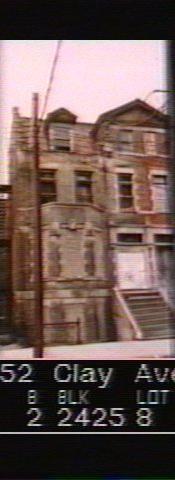
The city photographed every building for its tax records around 1940 and again in the 1980s. NYC Municipal Archives.
Written with AI from the source each entry cites, then fact-checked.
- 1897
William H. Morris dies and his heirs prepare the Fleetwood land for sale
After William H. Morris died in 1897, his land around Fleetwood Park passed to three heirs, Juliet Livingston, A. Newbold Morris and Mrs. Frederick J. de Peyster. None of them lived there, and with the southern Bronx filling up fast they wanted to sell to developers. The trotting track that had occupied this ground closed at the start of 1898.
“Following the death in 1897 of William H. Morris, his property in the Fleetwood area was divided among three heirs…”
- 1901
No. 1052 is built with a one-story bay and later loses its cornice to a false pent roof
No. 1052 was designed by Warren C. Dickerson in 1901-02 as the shorter half of an uneven pair with No. 1050, with a one-story-and-basement angled bay and beige Roman brick facing. The two share a third-story gable with a galvanized-iron pediment. Unlike its partner, No. 1052 has lost its original cornice, now replaced by a false pent roof, and its paired wood-and-glass entrance doors.
- 1905
A household headed by Henry Cabaud is recorded at No. 1052 in 1905
The 1905 state census lists No. 1052 as home to a man whose name the Landmarks Preservation Commission transcribed, with a question mark, as Henry Cabaud. He lived here with his mother, his daughter and an aunt who had been born in Ireland.
“Henry Cabaud [?], his mother, daughter, and Irish-born aunt are recorded as living at No. 1052.”
Nearby
- 1050 Clay Avenue3 entries
- 1054 Clay Avenue3 entries
- 1048 Clay Avenue3 entries
- 1056 Clay Avenue3 entries
- 1046 Clay Avenue3 entries
- 1058 Clay Avenue2 entries