Sun Building
280 Broadway | also 55 Chambers Street, 35 Reade Street | Civic Center | built 1910
Open on the map11 entries

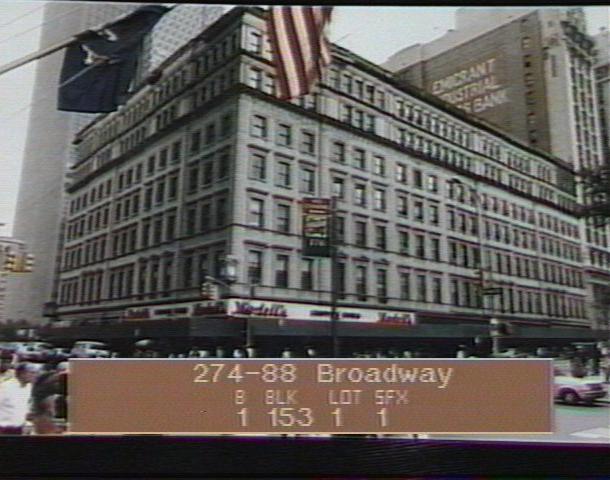
The city photographed every building for its tax records around 1940 and again in the 1980s. NYC Municipal Archives.
Written with AI from the source each entry cites, then fact-checked.
- 1844
Washington Hall, a hotel on the corner, burns down
Before Stewart's store, the southeast corner of Broadway and Reade Street held Washington Hall, a famous hotel designed by John McComb. It burned in July 1844. Work began in April 1845 on clearing the corner for the store, on a lot with 90 feet of Broadway frontage that ran back 123 feet along Reade Street.
- 1846
A.T. Stewart opens his marble dry goods palace, the first American department store
Designed by Joseph Trench and John B. Snook, Alexander T. Stewart's dry goods store opened at Broadway and Chambers Street on September 21, 1846. It is described as the first department store in the United States and the city's first commercial building in the Italianate style. It was enlarged several times, and Stewart moved his retail business uptown in 1862.
Source: Wikipedia
- 1853
A holdout lot owner forces Stewart's store to stop short on Chambers Street
When Stewart extended the store along Chambers and Reade Streets in 1852 and 1853, only two units went up on Chambers because the owner of the neighboring lot would not sell. Cast iron replaced marble at the ground floor, and on Reade Street also at the basement, with the ironwork supplied by Daniel Badger. By 1853 the store's yearly trade had reached $7,000,000.
“Only two were built on Chambers Street because the owner of the lot next to the 1850-51 addition refused to sell.”
- 1884
After Stewart's death, Henry Hilton turns the empty marble store into offices
Stewart died on April 10, 1876. His friend and executor Henry Hilton took over the real estate, moved the wholesale business out, and left the marble store empty for a while. In 1884 Hilton lengthened the building by two units on both Chambers and Reade Streets, raised it two stories and turned the inside into offices.
“In 1884, Hilton further extended the building two units along Chambers and Reade Streets, added two stories and converted the interior into an office building.”
- 1893
Hetty Green lends $1.25 million to Hilton's firm against the building
In August 1893 the financier Hetty Green loaned $1.25 million to Hilton, Hughes & Co., the firm that ran the Stewart stores and was in financial trouble. She took a five-year mortgage on 280 Broadway as security. The New York World called the loan a great blow to Henry Hilton's pride. The firm went bankrupt in 1896.
Source: Wikipedia
- 1906
Felix Isman buys an option on the building and turns down a $1 million quick profit
In April 1906 Felix Isman paid $4.5 million for an option to buy the Stewart Building. The New York Times reported that minutes after he signed, he turned down a resale offer that would have netted him $1 million. An injury in a 1907 railroad accident kept him from exercising the option at first, and he finally bought the building in June 1908. The Hilton estate sued to foreclose in June 1912.
“…a few minutes after signing the purchase agreement, Isman refused an offer to resell it for a $1 million profit…”
Source: Wikipedia
- 1917
The New York Sun moves in and hangs its clock over Broadway
Publisher Frank Munsey bought the building in 1917 and moved his newspaper, The Sun, into it. The paper added the four-sided clock at the corner of Broadway and Chambers Street, inscribed with its motto, It Shines for All. The Sun left in 1950; the building became a city landmark in 1986 and has housed the Department of Buildings since 2002.
Source: Wikipedia
- 1925
Publisher Frank Munsey dies and leaves the building to the Metropolitan Museum
Frank Munsey, who moved the Sun into the building in 1919, was a publisher known for closing or merging weaker papers. He never married. When he died in 1925, most of his estate, worth about $20 million, went to the Metropolitan Museum of Art, and that included the old Stewart store.
“On his death, the bulk of his estate, valued at about $20 million, was left to the Metropolitan Museum of Art, including the Stewart store.”
- 1928
The former department store is renamed the Sun Building
Three years after newspaper publisher Frank Munsey's death, William T. Dewart buys the marble-fronted building from the Metropolitan Museum of Art, which had inherited it from Munsey's estate, and renames it the Sun Building. The building had housed Munsey's New York Sun since 1919, and the new name marks the paper's long occupancy of its home.
Source: Wikipedia
- 1965
The city acquires the old department store through condemnation
Decades after A.T. Stewart's marble palace stopped serving as a store, New York City takes ownership of 280 Broadway through condemnation proceedings. The move brings the nation's first department store building into municipal hands, setting up its later use as office space for city agencies.
Source: Wikipedia
- 2002
The Department of Buildings moves into the restored landmark
Following a comprehensive restoration led by Beyer Blinder Belle that runs from 1995 to 2002, the city relocates the Department of Buildings' headquarters into 280 Broadway. The project revives the 19th-century marble facade while adapting the former dry-goods emporium for modern municipal offices.
Source: Wikipedia
Further reading
- 280 BroadwayWikipedia
- A thermometer and clock on a Broadway buildingEphemeral New York
Nearby
- 49 Chambers (Emigrant Industrial Savings Bank Building)49 Chambers Street | 13 entries
- Tweed Courthouse52 Chambers Street | 13 entries
- Broadway-Chambers Building277 Broadway | 7 entries
- 22 Reade Street (City Planning Building)22 Reade Street | 4 entries
- 287 Broadway8 entries
- Ted Weiss Federal Building290 Broadway | 15 entries