Van Cortlandt House
6036 Broadway | also 6200 Broadway | Van Cortlandt Park | built 1943
Open on the map9 entries

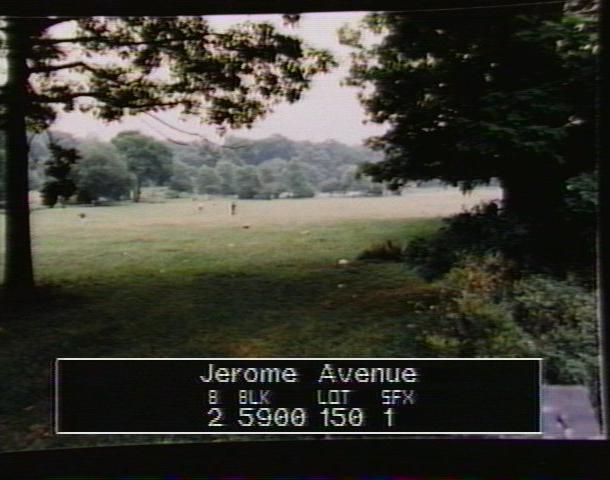
The city photographed every building for its tax records around 1940 and again in the 1980s. NYC Municipal Archives.
Written with AI from the source each entry cites, then fact-checked.
- 1748
The house rises in fieldstone with carved faces of the Cortlandts over its windows
A cornerstone on one corner carries the year 1748. The Georgian house, by an unknown designer, is two and a half stories of dressed fieldstone on an L-shaped plan, with brick window frames and a slate mansard roof with seven dormers. Each window keystone is carved as a grotesque mask with its own expression, said to represent a different member of the family.
“There are keystones above the windows, which contain carvings of grotesque masks.”
Source: Wikipedia
- 1749
Frederick Van Cortlandt dies before his new house is finished, leaving it and its slaves to his son
Frederick Van Cortlandt, who began the house in 1748, signed his will on October 2, 1749, noting the house was almost done. He died before completion and was buried in the new family plot on Vault Hill. The estate went to his son James, along with 11 or 12 enslaved people who worked the plantation; enslaved workers also did the cooking, cleaning and laundry in the house.
Source: Wikipedia
- 1776
British General William Howe makes the Van Cortlandt house his headquarters
Washington had used the house as his headquarters after the defeat at the Battle of Long Island and stayed there before the Battle of White Plains. After that second American defeat, General William Howe took it over as his own headquarters on November 13, 1776. Hessian soldiers had already looted the house before he arrived, scattering family papers.
“British General William Howe made the house his headquarters on November 13, 1776…”
Source: Wikipedia
- 1780
A wounded British captain dies in the house just after his fiancée arrives, starting a ghost story
In 1780 a British captain named Rowe was badly wounded in a fight nearby. He died in the house shortly after his fiancée arrived, and the episode gave rise to rumors that his ghost haunts the mansion.
Source: Wikipedia
- 1781
Washington plans with Rochambeau at the house and leaves campfires burning to fool the British
In 1781 George Washington came back to the house to plan with the Comte de Rochambeau while their troops waited on the fields outside. Instead of scouting British forts in upper Manhattan, the armies marched south to Virginia and the siege of Yorktown, and Washington kept fires lit by the house so the British would believe his soldiers had not left.
“Washington lit campfires outside the house to deceive the British into thinking that his troops were still on the grounds.”
Source: Wikipedia
- 1783
Washington and George Clinton stop at the house before entering Manhattan as the British leave
Washington's final stay came in 1783, once the Treaty of Paris had been signed. With British troops just gone from Manhattan, he and George Clinton stayed here before going into the city. The western parlor off the front hall served as Washington's quarters during that visit.
“Washington used the house one final time in 1783 after the Treaty of Paris.”
Source: Wikipedia
- 1810
The census counts 15 enslaved people in Augustus Van Cortlandt's household at the house
After the Revolution, City Clerk Augustus Van Cortlandt moved his family into the house. Census takers recorded 17 enslaved people on the property in 1790, and in 1810 his household listed six free people and 15 enslaved ones. Those enslaved on the estate gained their freedom in 1827, the year New York abolished slavery. The attic now holds an exhibit on the enslaved people who worked the plantation.
“The census of 1810 showed that Augustus's household consisted of six free people and 15 slaves…”
Source: Wikipedia
- 1888
The city buys the estate for Van Cortlandt Park and the house becomes a barracks, bison included
The city bought part of the estate on December 12, 1888, the same year the family finally left the house. Until 1896 the mansion housed New York State Police assigned to guard the bison roaming the new park, and city police and the National Guard used it too. The animals also lived at the house until their transfer to the Bronx Zoo.
Source: Wikipedia
- 1897
The Colonial Dames open the Van Cortlandt house as one of the city's first house museums
In December 1896 the city agreed to lease the mansion to the Society of Colonial Dames of the State of New York, which spent $4,000 to $5,000 restoring it. It opened to the public in May 1897, free most days with a 25-cent Saturday charge for upkeep, and logged more than 50,000 visitors in its first four years. The Dames still ran it as of 2023.
“The Colonial Dames took over the mansion on May 27, 1897, and opened the house to the public on that date.”
Source: Wikipedia
Further reading
- Van Cortlandt HouseWikipedia
Nearby
- 4456 Tibbett Avenue1 entry
- 4448 Tibbett Avenue1 entry
- Bitter House4440 Tibbett Avenue | 1 entry
- Horace Mann School Kindergarten Cottage II4430 Tibbett Avenue | 2 entries
- 4420 Tibbett Avenue2 entries
- 4414 Tibbett Avenue2 entries